The Other Side of Polymarket’s $299 Million Sports Week
Sports prediction markets made up more than half of Polymarket’s on-chain trading from September 14–20. We look at the liquidity behind that volume and what Kalshi’s record figures actually count.

This week’s Prediction Frontier letter turns to sports. They accounted for $299.3 million, more than half of Polymarket’s on-chain trading, from September 14–20. Esports added another $77.4 million.
That much trading needs someone willing to take the other side of each order. Flutter, FanDuel’s parent, sees a business there: the company expects about $50 million in market-making revenue this year from supplying liquidity to combination markets across prediction platforms.
Kalshi’s record week shows why it pays to look closely at the numbers behind that business. DeFi Rate counted $15.27 billion in displayed contract volume, but $3.53 billion when trades were valued at their execution prices.
Our first edition sports roundup examined a separate venue, Polymarket, and asked a related question: what sizes, prices and trading hours sit behind its sports volume?
The NFL has small typical trades and large money flows
The NFL traded $59.7 million on Polymarket during the week. Its median trade was $12.18, yet single tickets of $5,000 or more accounted for 69% of its volume. The ten largest wallets supplied 42%.
Soccer was larger overall at $137.6 million, but its median trade was $2.20 and tickets of $5,000 or more supplied 37% of volume. Tennis and esports each received less than 30% of their volume from tickets that size.
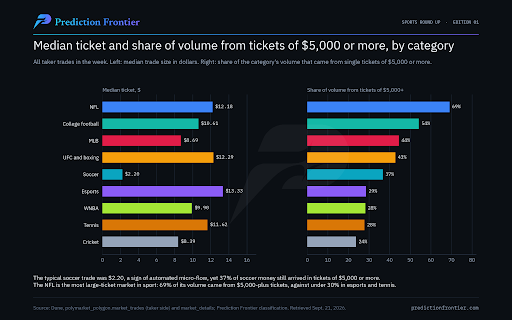
Image Source: Prediction Frontier Research
The NFL combines a lot of small trades with a much smaller number of trades that account for most of the money. Anyone offering to buy and sell throughout a game has to serve both: the $12 customer and the holder looking to move thousands of dollars at once. The weekly total alone hides that difference.
The biggest tickets were exits
The two largest sports trades in our sample were sales of contracts the traders already owned. One wallet sold $4.85 million of Chiefs contracts; another sold $3.27 million of Betis contracts. Both sold at 99.9¢, just short of the $1 each contract would pay if it won.
The sellers got their money immediately instead of waiting for settlement. Whoever bought at 99.9¢ paid almost the full potential payout for a chance to earn the remaining 0.1¢ per contract, while bearing the risk that it would pay nothing. The trade data does not identify those buyers as market makers.
Those sales illustrate one reason execution price matters. Across all soccer trades, 22% of volume changed hands at 97¢ or above, or at 3¢ or below. The shares were 27% for esports and 8% for MLB. These trades were not necessarily all cash-outs, but they took place at prices that strongly favoured one outcome.
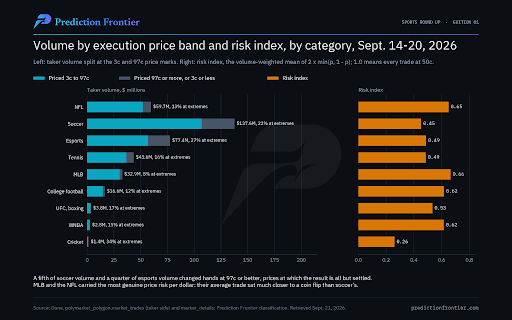
Image Source: Prediction Frontier Research
The NFL’s mix shifted within the week. On Monday, 48% of its volume traded at those extreme prices, including activity around the Chiefs sale. On Sunday, the share was 5%. For a liquidity provider, a large order at 99.9¢ presents a different decision from one placed at 50¢: how much money to commit for a small possible gain, and how much risk remains before settlement.
Every sport has its own trading hours
Esports did 52% of its volume before 10 a.m. US Eastern time. MLB did 58% after 6 p.m. The NFL peaked at 4 p.m. and again at 11 p.m.
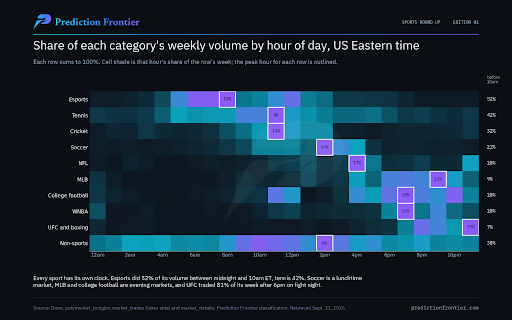
Image Source: Prediction Frontier Research
Sports trading does not keep one schedule. A market maker covering several sports needs to be ready for esports in the morning, MLB in the evening and the NFL around game time.
Add the small NFL tickets and the large 99.9¢ exits, and the opportunity comes into focus: being ready to quote a price when someone wants to trade, across very different order sizes, odds and hours.