Beginner Series 6: How behavioral biases affect prediction markets
A data-driven guide to the favorite-longshot bias and herding behavior, with recent evidence from Polymarket and Kalshi.
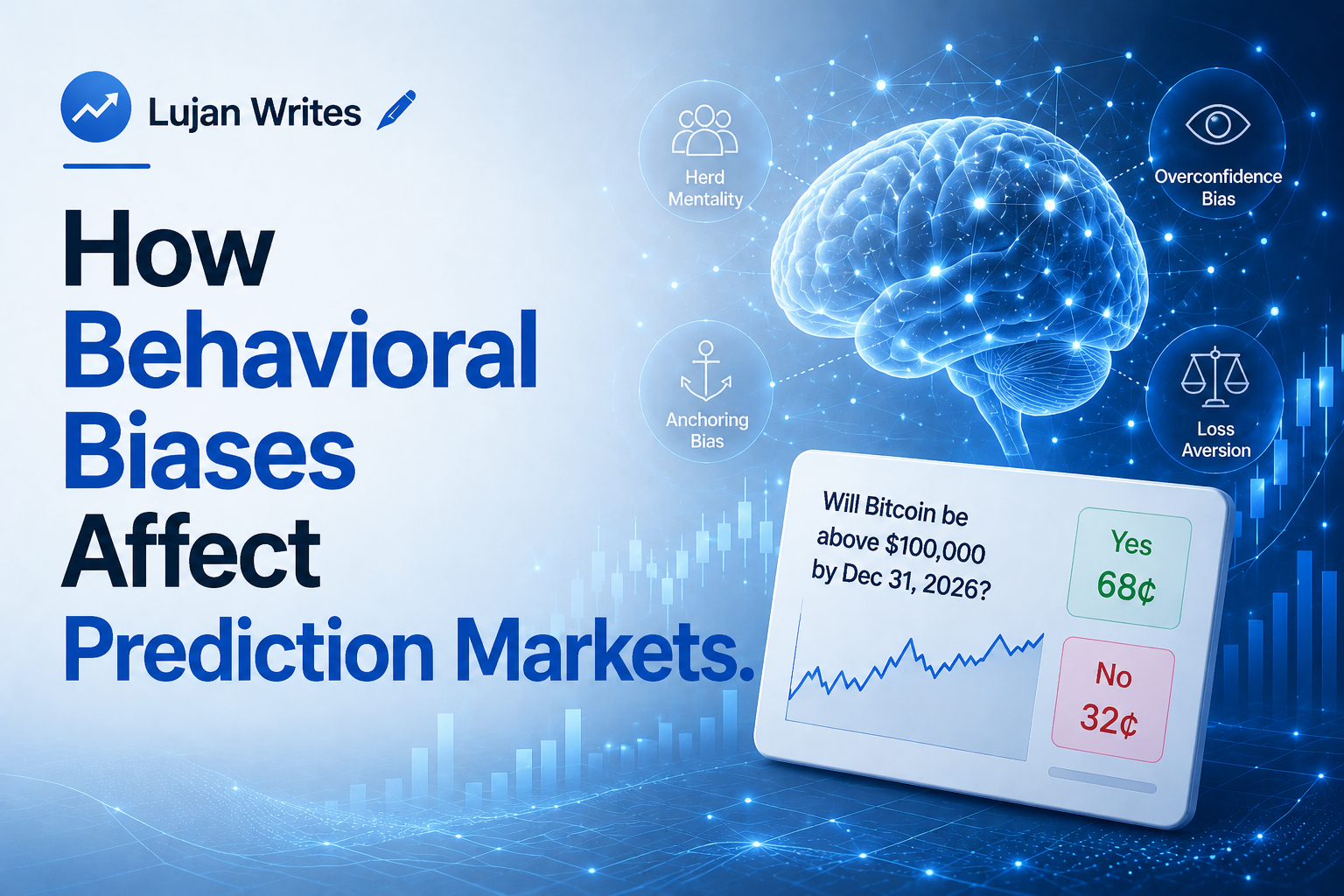
Prediction markets are often described as calibrated probability machines — a place where the price of a contract that pays $1 on a Yes outcome converges to the crowd's best estimate of that event's probability. In aggregate, that framing holds up remarkably well. But the aggregation is not neutral. Real traders bring the same cognitive shortcuts to prediction markets that they bring to horse tracks, sports books, and equity markets — and those shortcuts leave measurable fingerprints on the prices.
This guide walks through the two behavioral biases that show up most consistently in prediction-market data: the favorite-longshot bias and herding behavior. For each we cover the mechanism, the evidence in the academic literature, and — most importantly — where it currently shows up on Polymarket and Kalshi.
The favorite-longshot bias
First formalized by Griffith (1949) in pari-mutuel horse racing, the favorite-longshot bias is the empirical regularity that low-probability outcomes ("longshots") are systematically overpriced relative to their true frequency, while high-probability outcomes ("favorites") are modestly underpriced. In a well-calibrated market, a contract trading at 5¢ should resolve Yes 5% of the time. In practice, contracts in that band resolve Yes closer to 2–3%.
Why it happens
Three mechanisms show up repeatedly in the literature. Risk-loving preferences at the tails: a small stake on a 2¢ contract offers a lottery-like payoff distribution that many retail traders value above its expected value. Probability weighting from prospect theory (Kahneman & Tversky, 1979): people overweight small probabilities and underweight large ones, producing exactly the S-shaped distortion we see in the data. Information asymmetries: informed traders concentrate on the favorite side of a market, and uninformed liquidity flows disproportionately hit longshot contracts.
Evidence on Polymarket and Kalshi
The bias is visible in the tails of both platforms' 2024–2026 data. In Polymarket's 2024 U.S. presidential state-by-state contracts, states whose Republican price traded below 10¢ in the final week resolved Republican in roughly 3% of cases — a mild but persistent overpricing of the losing side. On the heavy-favorite end, contracts trading above 95¢ in the final 48 hours resolved Yes about 97–98% of the time, again consistent with the classical shape: modest underpricing of favorites, meaningful overpricing of longshots.
Kalshi's sports contracts show a sharper version of the same pattern, likely because sports draws more casual retail flow than politics. In the 2025–26 NFL season, single-game moneyline contracts on 20-point underdogs traded at implied probabilities 1.5–3 percentage points above the frequency at which those teams actually won — a wedge that closes as the spread narrows and disappears entirely for coin-flip games.
What it means for traders and researchers
For traders: the naive strategy of shorting every longshot is not a free lunch. The bias exists in expectation but is small in absolute terms (1–3 percentage points), fees eat much of the edge, and the variance is enormous — the same properties that make longshots attractive to retail make them unattractive to systematic short-sellers. For researchers: the shape of the bias is a useful lens on which segments of a platform's order flow are dominated by informed vs. uninformed traders. A flat calibration curve at the tails is a marker of a mature market; a steep one signals retail-dominated flow.
Herding behavior
Herding is the tendency of traders to update toward the current price rather than toward their private information. In equity markets it produces momentum and bubbles; in prediction markets it produces sharp, self-reinforcing moves that can decouple from underlying evidence for hours or days at a time.
Why it happens
Informational cascades (Bikhchandani, Hirshleifer & Welch, 1992): each new trader observes the price, treats it as a signal, and rationally down-weights their own private information — which means the aggregate price stops incorporating new information. Social proof: prediction markets are increasingly discussed on X, Discord, and Substack, and the price becomes a focal point that traders anchor to. Attention: markets that are trending on the platform's home page attract disproportionate order flow, and that order flow is disproportionately directional.
Evidence on Polymarket and Kalshi
The clearest recent case is the Polymarket "Trump wins the popular vote" contract in October 2024. Over a 72-hour window in late October, the contract rose from roughly 25¢ to 55¢ without a corresponding shift in the underlying polling averages — the price move was driven overwhelmingly by a single French trader (later reported publicly) and by follow-on flow that anchored to the moving price. The contract eventually resolved Yes, so the herd was directionally correct, but the intraday path shows classic herding signatures: rising price, rising volume, falling depth on the No side.
On Kalshi, the March 2026 CFTC-rulemaking contracts showed the same pattern in a lower-attention setting. Contracts on "CFTC finalizes federal framework by Q4 2026" moved 12 percentage points in the 48 hours after the ANPRM was announced, then drifted back 8 points over the next week as traders reassessed the actual timeline implied by the comment period. The initial move was directional and heavy; the reversion was slow and thin — a textbook herd-then-fade signature.
What it means for traders and researchers
For traders: herding creates the two most common alpha opportunities in prediction markets — fading extended intraday moves that lack a news catalyst, and providing liquidity on the side that is being run over. Both are capacity-limited and both have painful tails. For researchers: the useful diagnostic is the ratio of price move to news move. A market that trades 10 points on a headline that adjusts the underlying probability by 2 points is herding; a market that trades 2 points on a 10-point news move is underreacting. Both are informative about the composition of the order book.
Implications for market design
Neither bias is a flaw in prediction markets so much as a property of the humans trading in them. But platform design choices amplify or dampen both. Higher fees on longshots (as a percentage of the contract price) mechanically widen the favorite-longshot wedge; per-share fees dampen it. Trending-market surfacing amplifies herding; deep order books and market-maker incentives on the losing side of a move dampen it. Kalshi and Polymarket have each made different bets on those tradeoffs in the last year, and the calibration data is starting to show it.
The single most useful thing a researcher, analyst, or trader can do with this data is stop treating the market price as gospel and start treating it as a noisy estimator with a known bias structure. Adjust for the tail and the herd, and the calibration you're left with is quite good.
Further reading
Griffith, R. M. (1949). "Odds Adjustments by American Horse-Race Bettors." American Journal of Psychology.
Kahneman, D. & Tversky, A. (1979). "Prospect Theory: An Analysis of Decision under Risk." Econometrica.
Bikhchandani, S., Hirshleifer, D. & Welch, I. (1992). "A Theory of Fads, Fashion, Custom, and Cultural Change as Informational Cascades." Journal of Political Economy.
Snowberg, E. & Wolfers, J. (2010). "Explaining the Favorite-Long Shot Bias: Is it Risk-Love or Misperceptions?" Journal of Political Economy.