Sir Lewis Hamilton’s Impossible 96% Swing That Almost Nobody Acted On
Lewis Hamilton’s podium was priced at 2¢ and paid a dollar. The market that got it right traded about $17,000 in cash. What that says about depth, plus the deals and rulings that moved sports prediction markets this week.

At 4:51 p.m. in Sepang on Sunday, a contract on Lewis Hamilton finishing in the top three traded at 2¢ on Kalshi. He was running tenth on the wrong tyres in the rain. Eighty-eight minutes later he crossed the line third, and the contract was worth 98¢.
That move is the lead story in this week’s Sports Round Up. It is also the cleanest example we have found of a problem every institution looking at this asset class will meet: a market can read an event correctly, and liquidity can still be too small to be useful.
The Podium Craziness: Sir Lewis Hamilton’s 96% Swing
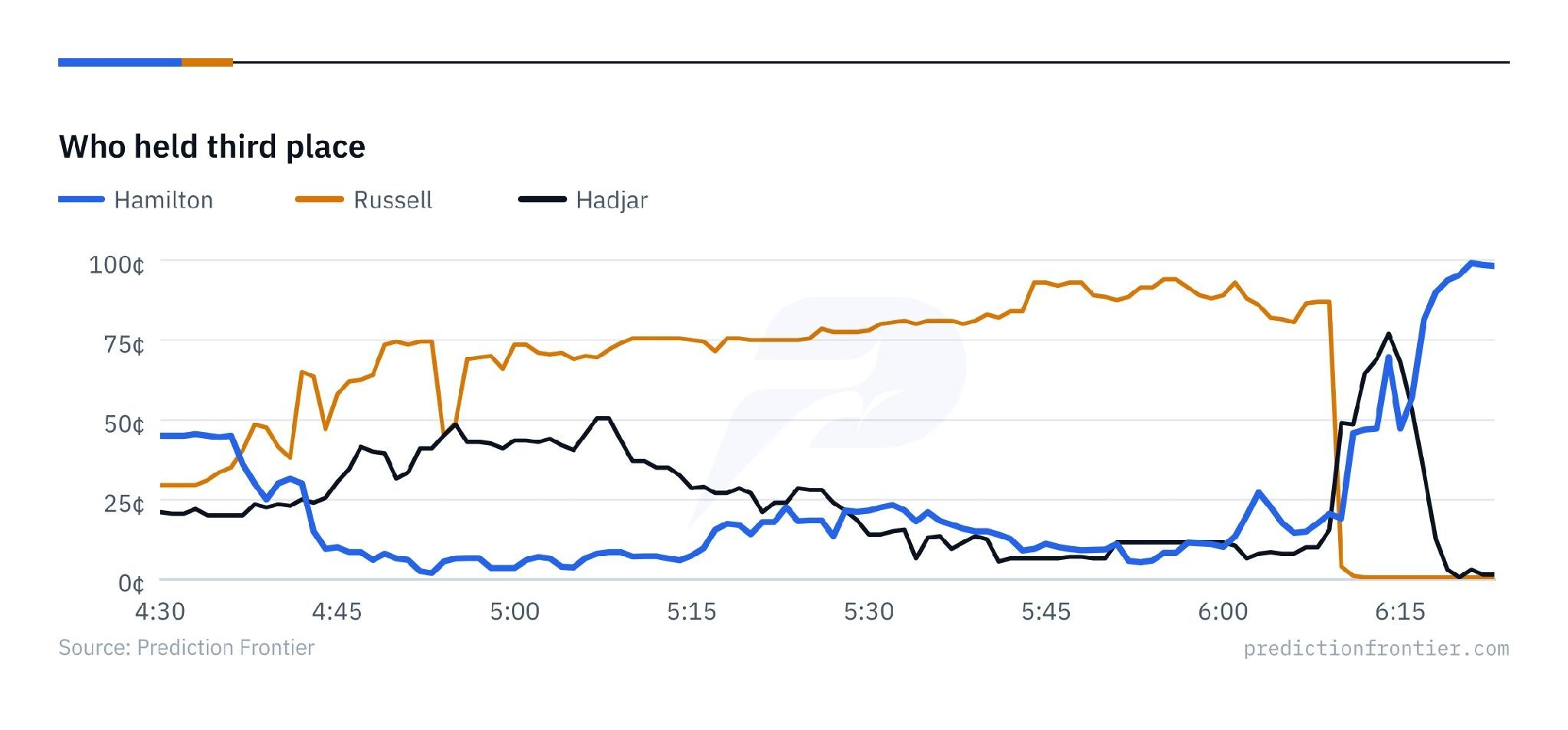
Max Verstappen won the Bahrain Grand Prix, moved to Malaysia after the April date was cancelled, and the winner market had him settled with an hour to go. The contest that kept moving was for third. Neither Polymarket nor Kalshi lists a contract on finishing exactly third, but both list a podium market, and with Verstappen and Kimi Antonelli running first and second, the podium price was for that one seat.
Hamilton owned it before the start at 45¢. Ferrari sent him out on slick tyres on a damp track, and four minutes into the race he was 9.5¢. George Russell, who had qualified eighth on the right tyres, took over, climbed from 35¢ to 65¢ in six minutes, and peaked at 94¢ on Polymarket and 96¢ on Kalshi.
Then Russell’s engine failed. He was at 87¢ at 6:09 p.m. and 4¢ a minute later. Isack Hadjar inherited third and reached 77¢ on Polymarket and 82¢ on Kalshi. For a moment, the Hadjar and Hamilton contracts added up to 147¢ for one seat. Hamilton made the pass at 6:16 p.m.
The bigger market saw none of it
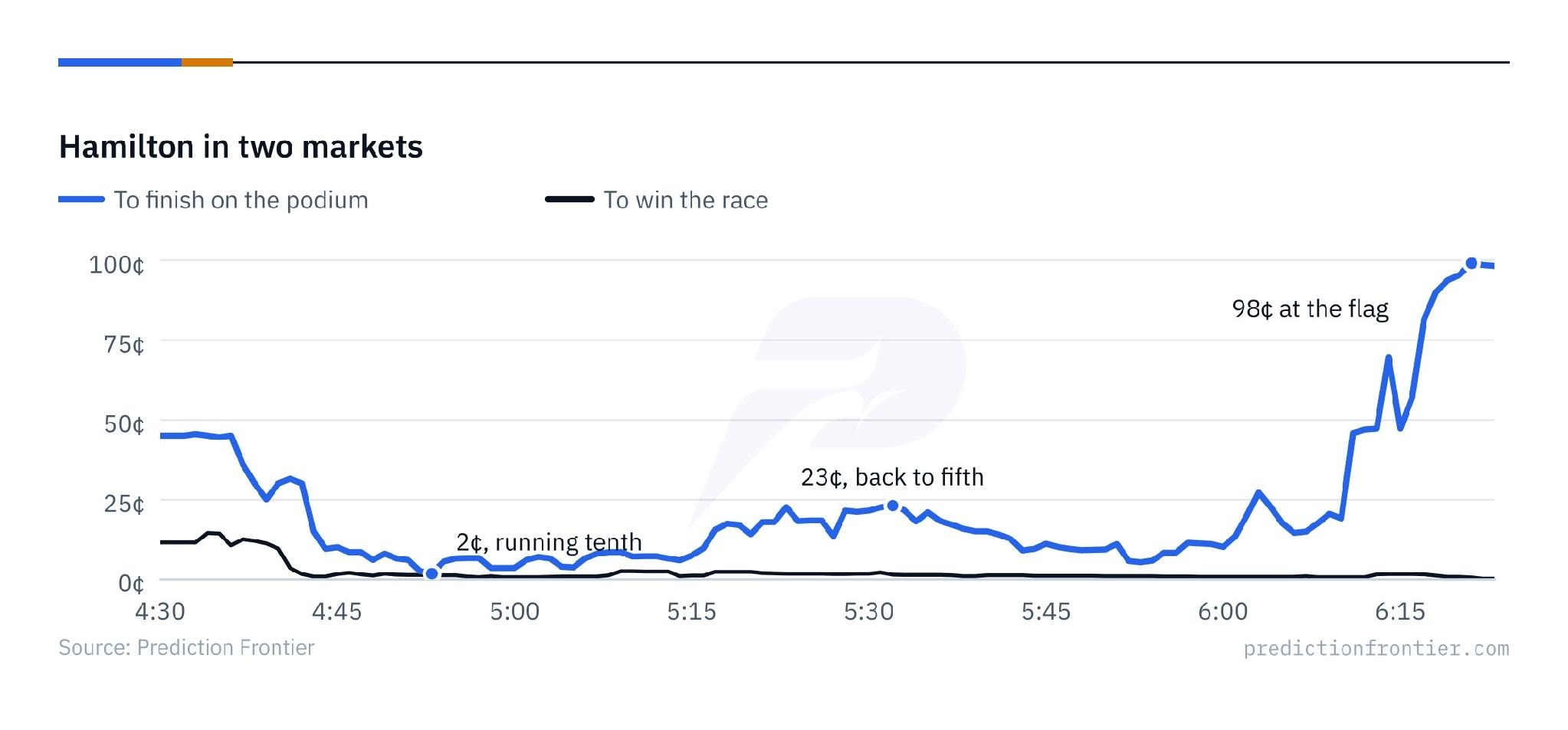
Hamilton’s price to win the race went to 1¢ at the start and stayed there. His whole recovery, including a climb to 23¢ when he reached fifth, shows only in the podium market.
The winner market was the larger of the two by about eight times on both exchanges: $652K on Polymarket and $1.84M on Kalshi, against $77K and $218K for the podium. It had one bad minute, when Antonelli led into the first corner, and Verstappen fell from 55.5¢ to 27.5¢. After that it barely moved.
So the smaller market carried the information, and almost nobody could act on it. While the race was on, about $17,000 in cash changed hands in the podium market on each exchange. On Polymarket, 14 wallets bought Hamilton under 10¢, for about $50 between them. Those shares paid $671.
The two exchanges agreed on price to within a few cents all afternoon. What they lacked was size. For an allocator, that is the useful finding: price quality in sports event contracts is ahead of capacity, and capacity is what a mandate needs.
Where the size is
Seven exchanges traded $23.3B at face value in the week, on DeFi Rate’s tracker. Single sports markets were $7.5B of that. Kalshi took $3.7B, Polymarket US $2.6B, and Polymarket’s international exchange $677M. Anyone modelling this sector from the international exchange’s on-chain data alone is looking at about 9% of the sports dollars.
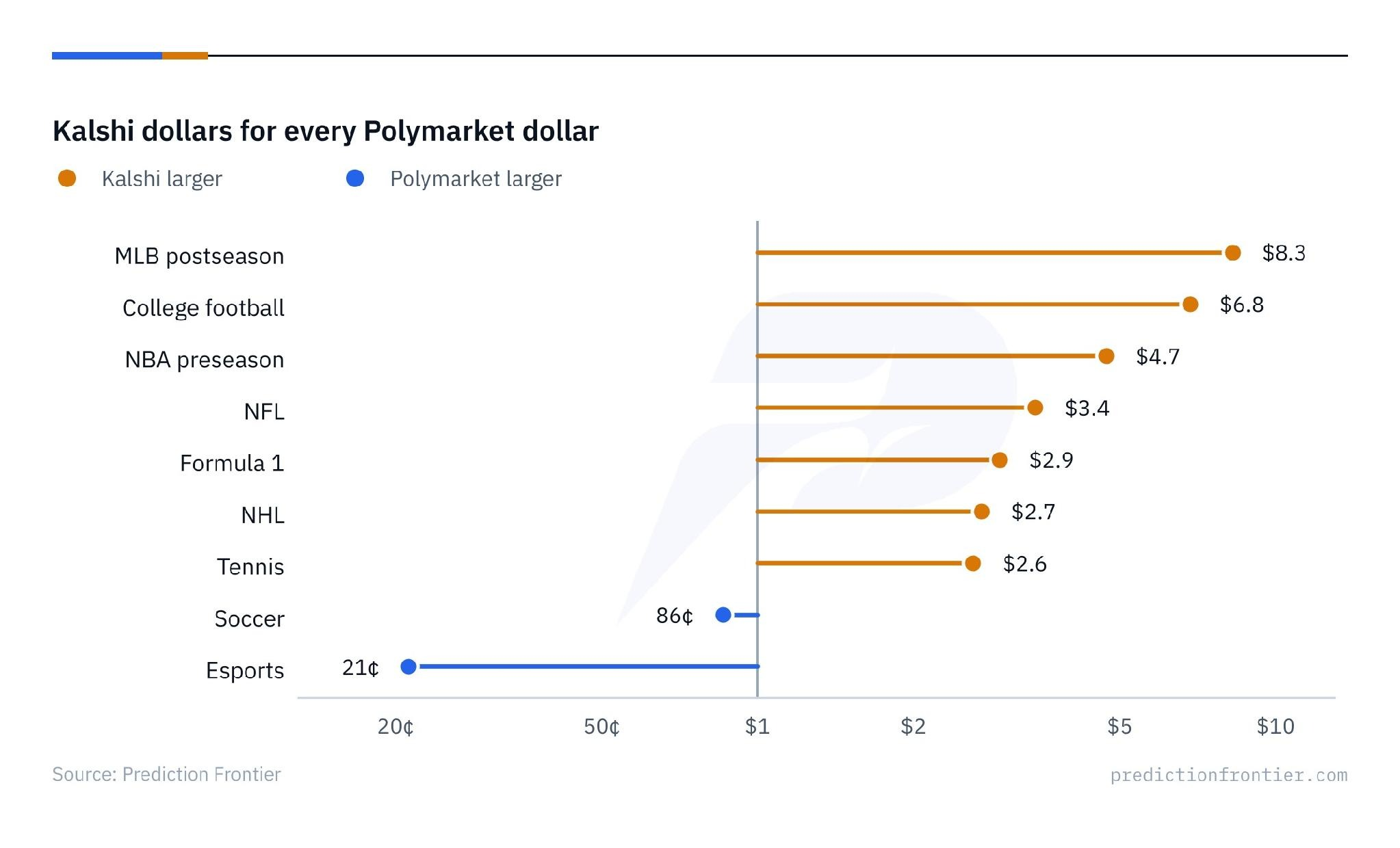
Sport by sport, the two main exchanges are close to mirror images. For every dollar Polymarket traded on postseason baseball, Kalshi’s winner markets traded $8.30. In college football it was $6.80 and in the NFL $3.40. In esports it was 21¢.
Three other findings from the full report:
The Eagles were priced at 97¢ against the Rams and lost. Thirty wallets bought the Rams under 10¢ for $10,600 and collected $235,931. Across 64 NFL games this season, 60 of the 75 teams that first reached 80¢ in play went on to win. Late prices have been honest.
Novak Djokovic’s five matches in Beijing drew $9.6M on Polymarket, and Carlos Alcaraz’s five in Tokyo drew $3.4M. Djokovic started two of his as the underdog, while Alcaraz was never priced below 77.5¢ at the first ball. Matches the market could not call drew the money.
Esports was Polymarket’s largest category at $194.4M, ahead of soccer, tennis and the NFL. Kalshi traded $41.2M.
The money this week
Capital kept arriving. Kalshi is in talks to raise $1 billion at a $40 billion valuation, with Sequoia and Wellington in talks to lead, Reuters reported on Sept. 30. Its May round valued it at about $22 billion. ARK Invest disclosed that it has added Kalshi shares to three of its ETFs, small positions bought on Sept. 18.
The supporting cast is being funded too. Market maker Raven raised a strategic round at a $90 million pre-money valuation from CMCC Global and Coinbase Ventures, and says it quotes on more than ten prediction market venues, Kalshi and Polymarket among them.
Distribution is consolidating around sports. Fanatics, which has 80 million sports customers, confirmed its entry through a partnership with Crypto.com and plans a $1 billion advertising push in 2027.
What we are watching in Week 4
Club soccer returns after the international window, and we have called for Polymarket soccer to top $190M. The NHL enters its second week, baseball its division series, and the NBA its second week of preseason, where Kalshi has traded $4.70 for every Polymarket dollar so far. Last week’s calls went two for four, and the scorecard is in the full report.
The full Week 3 report is now live. Download the full report here.