Beginner Series 4: How to Navigate, Profit From, and Use Political Prediction Markets as Your Information Edge
The article flows naturally from regulatory context → why markets work → how to read them → how to profit → future outlook, giving readers both the “why” and the “how” of political prediction markets!
Before reading this piece, read our beginner’s guide and check our second article to understand the difference between prediction markets and traditional betting. Our third piece delves into the top prediction market platforms in Africa, a list you wouldn’t want to miss.
This is part IV of the series “Beginner Series”, which aims to provide users with a deeper understanding of political prediction markets, how they compare with opinion polls, how to trade them, and how to become a professional investor in these markets.
Nothing has topped the political scene on prediction markets when looking at the volumes-per-market chart, except sports, which account for 80% of the volumes on these nascent platforms. The 2024 US Presidential election remains the single biggest market on Polymarket to date, grossing over $4 billion during its lifespan, only rivalled by the 2025 Super Bowl and 2026 FIFA World Cup winner charts, which grossed $1 billion and $735 million, respectively.
Notwithstanding, prediction markets have become a cornerstone in predicting upcoming elections faster than opinion polls or your favourite media channel — from the 2024 US Presidential elections, Emmanuel Macron’s re-elections, and recently, Hungary’s incumbent PM Viktor Orban’s ousting — have all been correctly predicted on these markets.
The problem? Most people don’t know how to read them, let alone profit from them.
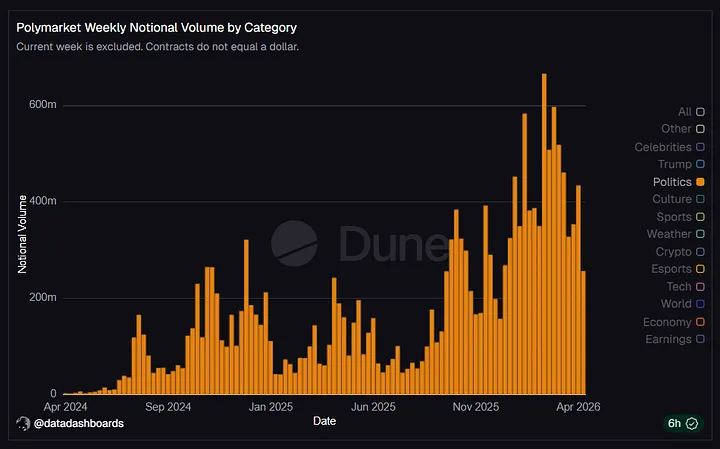
Weekly volumes on political markets on Polymarket (Source: Dune)
If you fall into the learner category, this piece is for you. We open up a new understanding for beginners in navigating, profiting from, and using political charts in the prediction markets space, helping them see these tools not as a “political betting “ site but rather as an information edge.
A Taste of Political Freedom
Political prediction markets are the rising star of prediction markets, whether on Polymarket, Kalshi, PredictIt, Limitless, or the hundreds of prediction markets popping up around Africa. Similar to sporting events, political contracts correspond to a simple ‘yes’ or ‘no’ question, allowing users to predict a wide range of questions, ranging from:
General elections
Congress laws
Policy recommendations
Trump
Global conflict and more
These contracts typically settle at $1 if the event occurs and $0 if it does not. Trading prices fluctuate between these values, reflecting the collective probability that the event will happen. For example, a contract priced at $0.65 implies the market believes there is roughly a 65% chance of that outcome.
Political markets haven’t always been a big start in prediction markets. However, this changed in September 2024 when Kalshi successfully challenged CFTC restrictions on election contracts, creating regulated pathways for Americans to participate in political forecasting markets. By 2026, the EU, Singapore, and Japan had established clear frameworks treating prediction markets as information aggregation tools under financial services regulations.
The Federal Reserve’s early 2026 research validated that Kalshi markets provide “high-frequency, continuously updated, distributionally rich benchmarks” valuable to policymakers. When the world’s most credible economic institutions endorse prediction markets as data sources, the landscape has fundamentally shifted.
Are Political Markets Better Than Opinion Polls?
Unequivocally, YES!
Political prediction markets offer users way more benefits than a static poll, given that the markets are constantly updating and changing to reflect the latest developments. Apart from this, prediction markets also offer:
Better Timing: Polls measure stated preferences at a snapshot in time. Markets aggregate beliefs in real-time, adjusting within minutes to breaking news. After President Biden’s poor 2024 debate performance, prediction markets adjusted immediately while polls took days.
Legit Incentives: Poll respondents risk nothing. Some polls are campaign-funded, designed to shape narratives. Political prediction market participants risk real money, creating accountability polls that can never be matched.
Information aggregation: Markets don’t just reflect polls — they synthesize polling data, campaign fundamentals, historical patterns, ground-game strength, and demographic shifts into one transparent probability.
More accurate track record: During the recent Hungarian PM Elections, polls heavily favoured long-term serving PM Viktor Orbán (albeit reports of media suppression). On Polymarket, the race remained favourably tipped to Péter Magyar, the opposition leader, at around 58%. Actual result? 55.26%. Prediction markets incorporating broader data performed better.
Nonetheless, Markets aren’t perfect — 2022 US midterms showed they can miss when trader psychology overcorrects. But the pattern across elections globally favors markets, especially as resolution approaches.
Reading Market Movements Like a Pro
Now that you understand political prediction markets better, how can you turn your political knowledge into a master predictor? One of the biggest takeaways from this section should be that price=probability. Simply, a $0.45 on a contract of “Will Democrats take the U.S. Senate in the upcoming Midterms?” means the market believes there is a 45% chance that Democrats will take over the Senate in the upcoming Midterm elections.
Becoming a pro needs time and concentration
And this is where you win or lose when predicting. Understanding what drives movement is what separates informed traders from noise. So how do you become a pro?
The Step-by-Step Guide to Profitable Political Trading
Step 1: Find Your Information Edge
Don’t trade elections, global events, or global conflict where you know nothing. Pick events where you have genuine advantages:
You live in the district and see the ground game strength firsthand
You understand polling methodology better than average traders
You follow campaign fundamentals (fundraising, staffing, advertising) obsessively
You have a historical data pattern recognition that others miss
Step 2: Wait for Market Inefficiencies
The best trades happen when markets misprice events due to:
Overreaction to single polls: One outlier poll shouldn’t move markets 15 points
Recent news bias: Markets overcorrect for the latest scandal or debate before settling
Narrative momentum: Media narratives create price distortions that fundamentals don’t support
Low-probability event mispricing: Markets are terrible at pricing true 5–8% chances, often pricing them at 2% or 12%
Step 3: Size Positions Appropriately
Never risk more than 5% of your account on a single political market. High-conviction trades deserve 5%. Testing ideas deserve 1%. Political markets can stay irrational longer than you can stay solvent.
Step 4: Take Early Exits
Don’t wait for a resolution. If you buy at $0.42 and the price hits $0.63 two weeks later, sell. Lock in 50% profit and redeploy capital. The candidate might eventually win (100% profit), but time-adjusted returns favor early exits.
Step 5: Track Every Trade
After 20–30 political trades, patterns emerge. You’ll see which market types you excel at (presidential vs congressional, domestic vs international) and which you should avoid. Your win rate matters less than whether high-conviction trades outperform low-conviction trades.
Step 6: Combine Multiple Data Sources
Never trade purely on market price or purely on polls. The best traders synthesize:
Current market pricing
Polling averages (weighted by quality)
Campaign fundamentals (money, organization, advertising)
Historical patterns (demographic shifts, turnout models)
On-the-ground observations (rally sizes, yard signs, volunteer enthusiasm)
Markets that diverge significantly from this combined analysis represent an opportunity — either the market is wrong, or your analysis needs updating.
What to Check while Trading Politics
Sharp moves = breaking news. A jump from $0.52 to $0.71 in twenty minutes signals material events — debate performance, scandal, major endorsement. These spikes often overcorrect before rational pricing returns.
Gradual trends = fundamentals. Slow drifts ($0.48 to $0.59 over three weeks) reflect accumulating information: improving organization, demographic shifts, and advertising effectiveness. These carry more predictive weight than spikes.
Volume tells the real story. High volume + stable prices = repositioning without new information. High volume + price movement = genuine information incorporation. Low-volume markets are manipulable — avoid them.
Watch multiple signals simultaneously: polling averages, fundraising, rally attendance, early vote data, and historical patterns. When markets diverge from this combined analysis, opportunity exists — either the market is wrong, or your analysis needs updating.
How To Use Markets as Superior Information Sources
Markets do the aggregation work for you, combining polls, fundamentals, and analysis into one transparent probability.
Data triangulation: Markets provide alternative probability estimates to compare against polls and your own analysis. During the 2024 US elections, a French trader commissioned independent polling with a different methodology than traditional pollsters, making $80 million by identifying market inefficiency.
Real-time nowcasting: Want a live probability of an election outcome? Open Polymarket or Kalshi. That number aggregates everything thousands of informed participants know, updating continuously. No calculations. No proprietary tools. Just transparent, readable probability.
Risk hedging: Industries affected by political outcomes can offset exposure through prediction markets — functionality that doesn’t exist with polls.
What 2026 Midterms Reveal About Market Evolution
The 2026 US midterms test whether lessons from 2022’s failures have been learned. In 2022, markets predicted a “red wave” that didn’t materialize — Republicans gained 9 House seats instead of 30+, flipped one Senate seat instead of four.
The failure was trader psychology buying narrative momentum without questioning fundamentals. Markets have adapted: liquidity increased 400% since 2022, institutional traders now provide sophisticated arbitrage and leverage opportunities, and platforms have improved resolution criteria and settlements.
Early 2026 signs are promising — markets price outcomes closer to fundamental models than narrative predictions. But election night will determine if markets have truly evolved beyond 2022’s mistakes.
The Future: Markets as Primary Political Information Sources
Within five years, checking prediction markets will be as automatic as checking polling averages. Journalists will cite market probabilities alongside polls. Campaigns will monitor market pricing as seriously as internal polling. Institutional investors will use political markets to hedge policy risk.
This isn’t speculation. The Federal Reserve already validates these markets as reliable data sources. Major financial institutions are integrating political event contracts into risk management frameworks. The infrastructure exists. Regulatory clarity provides legitimacy. Only adoption remains.
For individuals, the opportunity is now. Learn to read markets before they become as widely understood as stock prices. Develop trading strategies while inefficiencies still exist. Build the skills to profit from information edges that won’t last forever.
Political prediction markets aren’t replacing polls. They’re providing a superior alternative — faster, more accurate, financially incentivized, and transparently priced. Whether you use them purely as information sources or trade them for profit, understanding how they work is no longer optional for anyone serious about political forecasting.
The markets have spoken. Are you listening?
If you’ve made it this far, you’re exactly the kind of reader this series is written for. Follow Prediction Frontier on Medium, Substack, and Twitter for the next drop.