Beginner Series 5(II): Crypto Prediction Markets Explained: Mastering Polymarket’s Crypto Categories
This is a comprehensive introduction to the world of crypto prediction markets. The article covers the crypto prediction market landscape, the different market types, and how to shift your mindset while dealing with these markets.

This is the second piece of 3 of part V of the series “Beginner Series”.
If you are a beginner in the world of prediction markets, we strongly recommend reading the first part of this series, “Crypto Prediction Markets Explained: USDC, Wallets, and Getting Started,” to familiarize yourself with the fundamentals of prediction markets, how Polymarket works, and basic trading mechanics. This article assumes you have that foundational knowledge and are ready to develop advanced strategies for crypto-specific markets.
This comprehensive guide will transform you from a casual crypto trader into a strategic Polymarket operator. We’ll explore:
Essential knowledge and mental frameworks before trading crypto prediction markets.
Detailed breakdowns of each market type with real data and volume statistics.
By the end of this article, you’ll have a battle-tested playbook for navigating Polymarket’s crypto markets with confidence and precision.
The Crypto Markets Landscape on Polymarket
Crypto markets on Polymarket are among the platform’s most dynamic and high-volume categories. According to The Block’s data, the crypto category’s daily volume on Polymarket has consistently exceeded $40 million this year, peaking at $117 million on March 4. This places crypto markets as the third most liquid category on the platform, behind sports and political prediction markets.
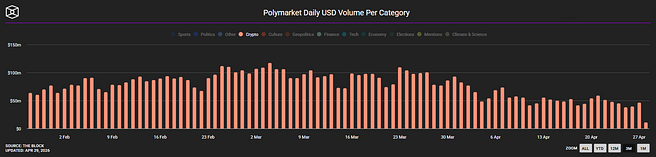
Daily USD volume for crypto category on Polymarket (February-April) Image: The Block
Currently, 260 markets are active in this category, spanning multiple timeframes and market structures. The crypto category has evolved into a sophisticated ecosystem offering traders multiple ways to profit from cryptocurrency price movements and market events.
So what are some of the major market types on crypto prediction markets?
Time-Based Up/Down Markets:
5-Minute Markets: Ultra-short-term binary predictions on whether BTC, ETH, or other assets will close higher or lower within a 5-minute window
15-Minute Markets: Similar structure with slightly longer timeframes
1-Hour Markets: Hourly price direction predictions
4-Hour Markets: Mid-range timeframe for swing trading approaches
Daily Markets: 24-hour price direction markets
2. Price Threshold Markets:
Above/Below Price: Binary markets on whether an asset will trade above or below a specific price point
Above/Below FDV (Fully Diluted Valuation): Markets on whether newly launched tokens will achieve certain market cap milestones
Number of $1B+ FDV Launches: Annual predictions on how many new tokens will reach billion-dollar valuations
3. Range and Target Markets:
Price Range: Multi-outcome markets where traders select which price bracket an asset will fall into
Hit Price by Date: Predictions on whether specific price levels will be reached by certain dates
Hit Price by End of Year: Annual price target markets
Hit Price by 2027: Long-term price prediction markets
The Fundamental Mindset Shift: You’re Not Predicting, You’re Arbitraging Probabilities
The single most important concept to internalize before trading crypto prediction markets is this: successful trading is not about being right about the future — it’s about finding mispriced probabilities.
When you see “Bitcoin Up — Next 5 Minutes” trading at 52¢, the market is saying there’s a 52% chance Bitcoin will close higher. Your edge doesn’t come from knowing the future; it comes from having a better probability estimate than the crowd. If you estimate 65% based on momentum indicators, order flow, and recent volatility patterns, you have a 13-point edge — that’s your profit zone.
Critical Pre-Trading Knowledge
A. Understanding Market Resolution and Oracle Mechanics
Polymarket uses the UMA Optimistic Oracle for market resolution. For crypto markets, this means:
Price data comes from Chainlink oracles for most BTC/ETH markets
Resolution occurs at the exact specified timestamp (not approximate)
There’s typically a 2–5 second delay between the actual price movement and market resolution due to blockchain confirmation times
For FDV markets, resolution sources are specified in each market’s rules (usually CoinGecko or CoinMarketCap)
This oracle latency creates opportunities (and risks) in ultra-short timeframe markets, which we’ll explore in Part 3 of this series.
B. The Law of Large Numbers vs. The Law of Small Samples
Short-term variance will destroy undercapitalized traders. Even with a genuine edge:
In 5-minute markets, you can easily go 0-for-10 despite having correct probability assessments
40% of traders quit after their first losing streak because they confuse short-term results with strategy quality
Top traders measure success over hundreds of trades, not dozens
Minimum recommended bankroll: $500-$1,000 for diversification across 5–10 positions. Serious traders operate with $5,000-$10,000 to enable proper position sizing without overconcentration.
C. Polymarket’s Fee Structure and How It Affects Strategy
As of January 2026, Polymarket implemented dynamic taker fees on 15-minute crypto markets to combat latency arbitrage:
Fees are highest when odds are closest to 50% (approximately 3.15% on a 50¢ contract)
This makes simple latency arbitrage unprofitable at scale
The fees decrease as probabilities move away from 50/50
Maker rebates are distributed daily to liquidity providers
This fee structure fundamentally changed short-term strategies, making information-edge and momentum-based approaches more viable than pure speed plays.
D. The Reality of Crypto Market Efficiency
Crypto prediction markets are less efficient than political or sports markets for several reasons:
Lower liquidity in many markets means wider spreads and more mispricing opportunities
Retail-dominated participant base (fewer institutional players than in traditional derivatives)
24/7 operation creates fatigue-based inefficiencies during off-peak hours
Rapid information flow in crypto creates brief windows where markets lag real-time data
However, efficiency is increasing rapidly. The era of “easy money” through simple arbitrage is largely over. In 2026, profitable trading requires:
Multi-source information aggregation (not just following one indicator)
Automated monitoring for time-sensitive opportunities
Sophisticated probability modeling that accounts for volatility regime shifts
Disciplined risk management that survives drawdown periods
Deep Dive: Types of Crypto Prediction Markets
A. Up/Down Markets (Time-Based Directional Bets)
Up/Down markets are binary predictions on whether a cryptocurrency will close higher or equal to its opening price at the end of a specified timeframe. These are the most actively traded crypto markets on Polymarket.
Question Format: “Bitcoin Up or Down — [Date], [Start Time] — [End Time]”
Example: “Bitcoin Up or Down — April 28, 3:00 PM — 4:00 PM ET”
Opening Price: BTC price at 3:00 PM ET (from Chainlink oracle)
Closing Price: BTC price at 4:00 PM ET (from Chainlink oracle)
Resolution: “Yes” (Up) if closing ≥ opening; “No” (Down) if closing < opening
Key Point: A tie (no change) resolves to “Yes” (Up), giving a slight statistical edge to the Up side in ranging markets.
i. Daily Markets
Timeframe: 24-hour windows (typically midnight to midnight ET)
Volume: Moderate-to-high ($50K-$500K per market)
Typical Spread: 48/52 to 45/55 (tighter during low volatility, wider during high volatility)
Attracts fundamental analysts and macro traders
Less susceptible to manipulation due to a longer timeframe
Influenced by: macroeconomic news, regulatory announcements, major market moves
Best For: Traders who analyze daily trends, support/resistance levels, and macroeconomic catalysts.
ii. 4-Hour Markets
Timeframe: 4-hour windows (e.g., 12:00 PM — 4:00 PM ET)
Volume: Moderate ($20K-$150K per market)
Typical Spread: 47/53 to 44/56
Sweet spot for technical analysis traders
Enough time for trends to develop
Not too short to be pure noise
Can be influenced by scheduled news (FOMC, jobs data, etc.)
Best For: Technical traders using 15-min to 1-hour chart analysis.
iii. 1-Hour Markets
Timeframe: 1-hour windows
Volume: Moderate ($15K-$100K per market)
Typical Spread: 46/54 to 43/57
Transition zone between technical and microstructure analysis
Momentum strategies start to become relevant
Order flow analysis can provide an edge
Still influenced by fundamental news, but faster reaction times are required
Best For: Active traders who can monitor markets continuously and react to intraday developments.
iv. 15-Minute Markets
Timeframe: 15-minute windows
Volume: Lower-to-moderate ($5K-$50K per market)
Typical Spread: 45/55 to 40/60
Dynamic fee structure implemented in January 2026 (up to 3.15% at 50/50 odds)
High noise-to-signal ratio
Susceptible to order book spoofing and microstructure manipulation
Requires real-time monitoring and fast execution
Latency is still possible, but less profitable post-fee implementation
Best For: Scalpers with automated systems and direct Oracle access.
v. 5-Minute Markets
Timeframe: 5-minute windows
Volume: Low ($2K-$20K per market)
Typical Spread: 44/56 to 35/65 (highly variable)
Highest noise-to-signal ratio of all timeframes
Dominated by automated bots and latency arbitrageurs
~15–20% of 5-minute periods resolve based on movements in the final 10 seconds
Oracle latency (2–5 seconds) creates both opportunity and risk
Best For: Sophisticated automated traders with direct Chainlink oracle monitoring and sub-second execution capabilities. NOT recommended for manual traders.
B. Above/Below Markets
Above/Below markets ask whether an asset will trade above or below a specific threshold at a defined time or during a defined period.
i. Price Above/Below Markets
Question Format: “Bitcoin above $_____ on [Date]?”
Example: “Bitcoin above $80,000 on April 28, 11:59 PM ET?”
Resolution Source: Chainlink BTC/USD price feed at the specified timestamp.
Single-point resolution: No averaging, just the price at that exact moment
Useful for hedging spot positions
Can create “pin risk” where markets cluster near the strike price as expiration approaches
Often used by miners and crypto treasury companies for hedging
Volume: Varies widely ($10K-$500K depending on proximity to current price and time to expiration)
Trading Dynamics:
If BTC is at $78,000 and the strike is $80,000 with 2 hours to expiration:
“Yes” might trade at $0.35 (35% implied probability)
Actual probability based on 2-hour realized volatility might be closer to 28%
Edge: 7 percentage points
ii. FDV (Fully Diluted Valuation) Markets
Question Format: “[Token] FDV above $_____ one day after launch?”
Example: “MegaETH market cap (FDV) one day after launch above $600M?”
Resolution Source: Typically CoinGecko or CoinMarketCap, specified in market rules.
Highly speculative nature attracts both informed participants (VCs, early investors) and retail speculation
Information asymmetry is significant — insiders often have better estimates than public markets
Volume can be enormous for hyped launches ($5M-$20M per market)
Resolution time (24 hours post-launch) allows for price discovery but also manipulation
Risk Factors:
Insider trading concerns (early investors manipulating the launch price)
Thin on-chain liquidity makes FDV calculations unreliable
Exchange listing timing affects resolution
iii. Annual Milestone Markets
Question Format: “Number of coins launched this year reaching $1B+ FDV?”
Example: “How many tokens reach $1B+ FDV in 2026?”
Multi-outcome structure: Brackets like “0–5”, “6–10”, “11–15”, “16–20”, “>20.”
Characteristics:
Long timeframe (annual resolution)
Requires macro crypto market analysis
Influenced by: funding environment, market sentiment, narrative cycles
Relatively thin liquidity early in the year, increasing toward resolution
C. Price Range Markets
Question Format: “What price will [Asset] hit in [Month/Year]?”
Example: “What price will Bitcoin hit in April?”
Multi-outcome structure: Multiple price brackets
“Hit” markets resolve Yes if the asset trades at that level at any point during the period (not closing price)
Can create interesting correlation structures (multiple outcomes can both be “Yes”)
Requires understanding of maximum/minimum price discovery, not just directional bias
Trading Considerations:
Early in the month, wide brackets tend to be underpriced
As time passes, probabilities consolidate toward realized ranges
Useful for volatility plays (buying both high and low brackets if expecting large moves)
Volume: High for major assets ($30M-$50M for Bitcoin monthly markets)
D. Hit Price by Date Markets
These markets ask whether an asset will reach a specific price level at any point before a deadline.
i. By Specific Date
Question Format: “Will [Asset] hit $_____ by [Date]?
Example: “Will Bitcoin hit $150,000 by December 31, 2026?”
Resolution: “Yes” if the asset trades at or above the level at any point before the deadline; “No” otherwise.
Path-dependent outcomes create volatility premiums
Early resolution possible (market closes if target is hit)
Higher time value early in the period
Influenced heavily by implied volatility in options markets
ii. By End of Year
Question Format: “Will [Asset] hit $_____ by EOY [Year]?”
Popular Variants:
“Bitcoin above $120,000 by December 31, 2026?”
“Ethereum above $8,000 by December 31, 2026?”
Characteristics:
Annual planning horizon attracts institutional participants
Often used for structured products and portfolio hedging
Probabilities reflect both directional bias and volatility expectations
iii. By 2027 (Long-term)
Question Format: “Will [Asset] hit $_____ by end of 2027?”
Characteristics:
Lowest liquidity but highest potential mispricing
Incorporates multiple market cycles
Useful for fundamental analysts with multi-year views
Less susceptible to short-term noise
Conclusion: Becoming a Profitable Polymarket Crypto Trader
Crypto prediction markets on Polymarket represent one of the most dynamic and opportunity-rich trading environments in 2026. However, success requires more than just knowing which button to click.
In this article, we have covered all the important crypto prediction markets you need to know to start trading across Polymarket, Kalshi, or tens of other platforms cropping up around Africa. We discuss the fundamental mindset shift you need to have, as crypto prediction markets offer more opportunity (and more risk) than directly trading crypto or other prediction markets, such as politics, weather, and even sports.
In part 3 of this brilliant series, “Crypto Markets Explained”, we will discuss battle-tested winning strategies for each of these market types and the risks to avoid in your journey to become a professional crypto prediction markets user. Additionally, we discuss advanced risk management strategies and bankroll strategies that will help you grow from a noob to a pro in time.
If you’ve made it this far, you’re exactly the kind of reader this series is written for. Follow Prediction Frontier on Medium, Substack, and Twitter for the next drop.
Disclaimer: This article is for educational purposes only. Crypto prediction market trading involves substantial risk of loss. Past performance does not guarantee future results. The strategies described require significant capital, technical infrastructure, and risk management discipline. Always conduct your own research and never risk more than you can afford to lose. Prediction markets may be subject to gambling regulations in your jurisdiction — ensure compliance with local laws.