Prediction Markets Sustained Conviction in a Fed Hold. Now Comes the Business-Model Test
Prediction markets maintained a Fed hold as the dominant outcome despite rising hike odds, while Robinhood’s $156 million quarter and emerging corporate hedges pointed to a broader test of the category’s durable financial value.

Citadel Securities broke from consensus on Monday, with head of macro strategy Frank Flight projecting the Fed would deliver a surprise quarter-point hike to cement Chair Kevin Warsh's inflation-fighting credibility.
Interest-rate swaps responded, with implied odds of a hike touching 40% ahead of Wednesday's decision, an unusually high level of pre-meeting uncertainty by recent standards. CME FedWatch ran slightly cooler, with the probability hovering in the mid-30s.
But prediction market traders never allowed the most dramatic scenario to become the base case.
Polymarket’s market maintained approximately a three-in-four probability that the Federal Reserve would leave rates unchanged. The crowd held its ground and the Federal Open Market Committee ultimately voted 9–3 to maintain the target range at 3.50%–3.75%. Three policymakers preferred a 25-basis-point increase.
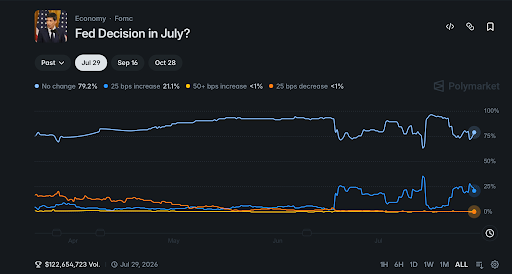
The result was not simply a victory for the crowd over institutions. Traditional derivatives also continued to price a hold as the most likely outcome. The more important distinction was in the level of conviction: prediction markets absorbed a credible institutional challenge, repriced the alternative and still preserved the correct outcome as the clear favourite.
The $600,000 Trade Shows Where Hedging Could Go
The most commercially significant part of the FOMC story may not have been the final probability.
Ahead of the decision, Marex reportedly facilitated a $600,000 block trade on Kalshi for a client seeking protection against a surprise rate increase. The event contract offered a direct payout based on whether the Federal Reserve increased rates, rather than requiring the client to hedge through an instrument whose value would only respond indirectly to the decision.
This distinction in this type of hedge matters.
Prediction markets have mostly entered mainstream consciousness as forecasting tools or speculative products. But a company, fund or financial institution exposed to a specific binary outcome may value the contracts for a different reason: they can isolate the event itself.
A conventional interest-rate instrument prices the wider path of monetary policy, liquidity, inflation expectations and market positioning. An event contract can instead ask a narrower question: Will the Federal Reserve raise rates at this meeting?
NEXTPredict.io, organizer of the NEXTPredict prediction markets conference, has also paid a $12,000 premium for contracts that could return $3 million if more than half of scheduled arrivals at JFK are cancelled on October 21, the main travel day before its October 22–23 summit. NEXTPredict described the transaction as the first documented use of a prediction market to hedge the financial exposure of a major conference. Susquehanna provided the other side of the trade.
Meanwhile, CME announced a partnership with FutureSports to list futures and options based on rules-driven sports-performance indexes. The planned cash-settled products will transform official team and athlete statistics into continuously priced benchmarks.
FutureSports says potential users include stadium operators, sponsors, insurers, apparel manufacturers and broadcasting partners seeking to manage sports-related commercial exposure. The first products are expected to begin trading during the summer, subject to regulatory review.
Taken together, these developments suggest that event-based finance is developing along two tracks:
Simple outcome contracts distributed through consumer applications.
More conventional derivatives designed around institutional price discovery and risk transfer.
For Prediction Frontier, the bigger theme is the emergence of a wider event-risk market.
A company exposed to team performance, tournament progression, weather disruption, interest-rate decisions or another measurable event may no longer have to accept that exposure as completely unhedgeable.
Some of these risks will be better served by insurance. Others will be better suited to futures, options or swaps. A narrower group may fit binary event contracts.
The commercial opportunity lies in identifying which instrument works for which exposure, not in labelling every new product a prediction market.
Robinhood’s event-contract revenue surpasses equities and crypto
Robinhood supplied the week’s clearest evidence that prediction markets are already commercially significant.
The company reported a record $1.31 billion in second-quarter revenue. Event contracts generated $156 million, increasing more than tenfold year over year and exceeding the $129 million generated by equities and the $100 million generated by cryptocurrency trading. Robinhood users traded a record 13.6 billion event contracts during the quarter.
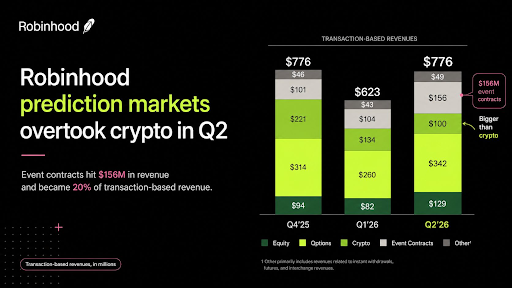
Prediction markets are no longer an experimental tab inside the Robinhood application. They are now one of its largest transaction-revenue businesses.
Robinhood’s prediction market trajectory demonstrates that speculation may still be the strongest onboarding product in consumer finance.
Event contracts are simple, timely and culturally legible. A customer may not understand discounted cash-flow models or portfolio construction, but they probably have an opinion on the Federal Reserve, an election, a football match or the outcome of a major cultural event.
That makes prediction markets an unusually effective entry point into a financial application. The most important question, however, is what kind of customer behaviour this growth creates over time.
If those users remain active only around the World Cup, elections and major macroeconomic events, the revenue may still be substantial but episodic and increasingly dependent on speculative activity.
Durable strategic value, however, should eventually become visible through retention, cross-product adoption and broader customer outcomes, not only contract volume.
Sports Leagues Want a Say in What Gets Listed
Sports remains the category’s largest distribution opportunity and its most immediate contest over both regulatory and institutional control.
The NBA, MLB, NFL, NCAA, ATP Tour and players’ unions representing athletes across the major U.S. leagues submitted responses to the CFTC’s proposed sports-event-contract framework this week.
Although their positions differ, the submissions converge around one demand: leagues do not want federally regulated exchanges building increasingly granular markets around their competitions without formal integrity obligations or meaningful consultation.
This could set up a structural contest over control.
Exchanges want the freedom to innovate and list new products. Leagues want authority over integrity, data and the commercial use of their events. State regulators continue to argue that sports event contracts are moving activity away from systems they historically oversee.
The outcome will shape not only which contracts can be offered, but also which institutions capture the economics around sports data and fan engagement.

New from the Prediction Frontier Research Desk
Our World Cup Special Report goes beneath the record headline volumes to map capital concentration, liquidity shifts and trading activity across the tournament, as well as outlining what to watch in the post-World Cup market.
Read the full World Cup Special Report → https://gtjpxeomgpuhbrbwqvqq.supabase.co/storage/v1/object/public/report-files/7a8706f3-e1c2-47b9-8bf3-e41c39d87622.pdf
Culture watch: Netflix sees speculation, but misses infrastructure
Netflix’s Instadocs: The Prediction Games brought prediction markets to a significantly wider audience this week.
While the documentary had hits and misses, it is strongest when showing the human consequences of trading: losses, information asymmetry, professional advantages and the risks created when money depends on evidence that market participants may be able to influence.
Its most notable omission is the category developing beyond speculative consumer trading.
The documentary gives little attention to businesses using contracts as potential hedges, institutional trading infrastructure, market-data distribution, compliance technology or internal forecasting markets that do not require employees to risk personal money.
That omission reflects the tension running through the entire sector.
Prediction markets may become valuable forecasting infrastructure, a new risk-transfer system and a major financial-data category. They may also become another highly optimized channel for selling frequent speculative activity to retail users.
More likely, both outcomes will coexist.