Prediction markets need a global strategy before America decides their future
The US remains too valuable for the largest platforms to walk away from. For smaller entrants, the cost of competing there makes a credible overseas business worth building now.

A platform can win an American customer today and lose the right to offer that customer its most popular contracts before the acquisition spend pays back.
That possibility became harder to dismiss on 17 November, when a federal appeals court refused to stop Maryland from applying its gambling laws to Kalshi's sports contracts. Other appeals courts have reached conflicting conclusions, and New Jersey has already asked the US Supreme Court to intervene. The uncertainty now reaches beyond the legal department into decisions about marketing budgets, distribution and where to build next. [1][2]
There is an overseas business to build. Kalshi says its international retail operation is approaching $100 million in annualised trading fees. Gibraltar has authorised prediction-market operators, while Nevis has introduced a dedicated licence. But a licensing jurisdiction and a profitable customer market are two different things. [3][4][5]
For a large exchange, the sensible response is to keep defending the US business while developing other sources of fees. A smaller entrant has a tougher choice. Money committed to US promotions and litigation cannot also fund a local distributor, payments integration or market makers elsewhere. Its best opening may be a narrower overseas product that the largest platforms have little reason to prioritise yet.
The US business is worth defending
American sports bettors already support a substantial industry. The American Gaming Association's annual report puts 2025 commercial sportsbook revenue at $16.89 billion. That excludes sportsbooks in tribal casinos and Florida's tribal mobile market. The AGA opposes the federal sports-contract model, but its figures help explain why exchanges want access to these customers. [6]
Sports have brought substantial activity to prediction markets too. Pew Research Center's analysis of The Block data records $58 billion of sports trading on Kalshi and almost $22 billion across Polymarket's venues in June and July, around the World Cup. These are global notional figures, counting contracts at full payout value, rather than operator revenue. [7]
DraftKings provides a more direct indication of what an incumbent thinks the opportunity is worth. On 5 November, it forecast $650 million to $750 million of Predictions revenue in 2027, alongside $250 million to $350 million of adjusted EBITDA investment in the business. It expected 2026 Predictions revenue to be immaterial because promotions would offset most gross revenue. These are management forecasts; the investment figure is not a measure of customer acquisition cost. [8]
A business with an existing customer base and income from other products can afford a long build. A new exchange has to earn its place with fewer resources. The US may offer the biggest prize without offering every entrant the best return on its next dollar.
Court risk is already affecting access
Kalshi argues that federal commodities oversight of its exchange displaces conflicting state gambling rules. That argument has produced different outcomes on appeal.
| Appeal | Decision date in 2026 | Position on preliminary protection |
|---|---|---|
| Third Circuit, New Jersey | 6 April | Upheld an injunction protecting Kalshi from state enforcement. [9] |
| Ninth Circuit, Nevada | 28 August | Largely upheld dissolution of protection against enforcement. [10] |
| Sixth Circuit, Ohio and Tennessee | 25 September | Ruled against Kalshi in the consolidated injunction appeals. [11] |
| Fourth Circuit, Maryland | 17 November | Affirmed denial of Kalshi's injunction, by two votes to one. [1] |
Third Circuit, New Jersey
Decision date in 2026: 6 April
Preliminary protection: Upheld an injunction protecting Kalshi from state enforcement. [9]
Ninth Circuit, Nevada
Decision date in 2026: 28 August
Preliminary protection: Largely upheld dissolution of protection against enforcement. [10]
Sixth Circuit, Ohio and Tennessee
Decision date in 2026: 25 September
Preliminary protection: Ruled against Kalshi in the consolidated injunction appeals. [11]
Fourth Circuit, Maryland
Decision date in 2026: 17 November
Preliminary protection: Affirmed denial of Kalshi's injunction, by two votes to one. [1]
Appellate position checked on 18 November 2026. These decisions concern preliminary protection. An adverse ruling does not itself establish that every platform or every state in the circuit has stopped trading.
The commercial effect is clearer where an order actually restricts access. Michigan's September injunction prohibits Kalshi's sports wagering and requires licensed geolocation controls. Nevada's July stipulation requires geofencing under its state-court injunction. Washington also has an order restricting sports and several other categories. In Louisiana, a November state order prompted a federal lawsuit by the CFTC. [12][13][14][15]
New York's enforcement case also returned to state court on 19 November, after a federal judge found no subject-matter jurisdiction. The remand determines where the case proceeds; it does not itself impose a trading ban. [41]
Even a partial measure shows why those restrictions matter. Nevada reported $601.4 million of sportsbook win in calendar 2025. Michigan's internet sportsbooks reported $671.3 million of gross receipts. Together, that is about $1.27 billion of established annual sportsbook revenue in just two states with orders restricting Kalshi's sports business. [16][17]
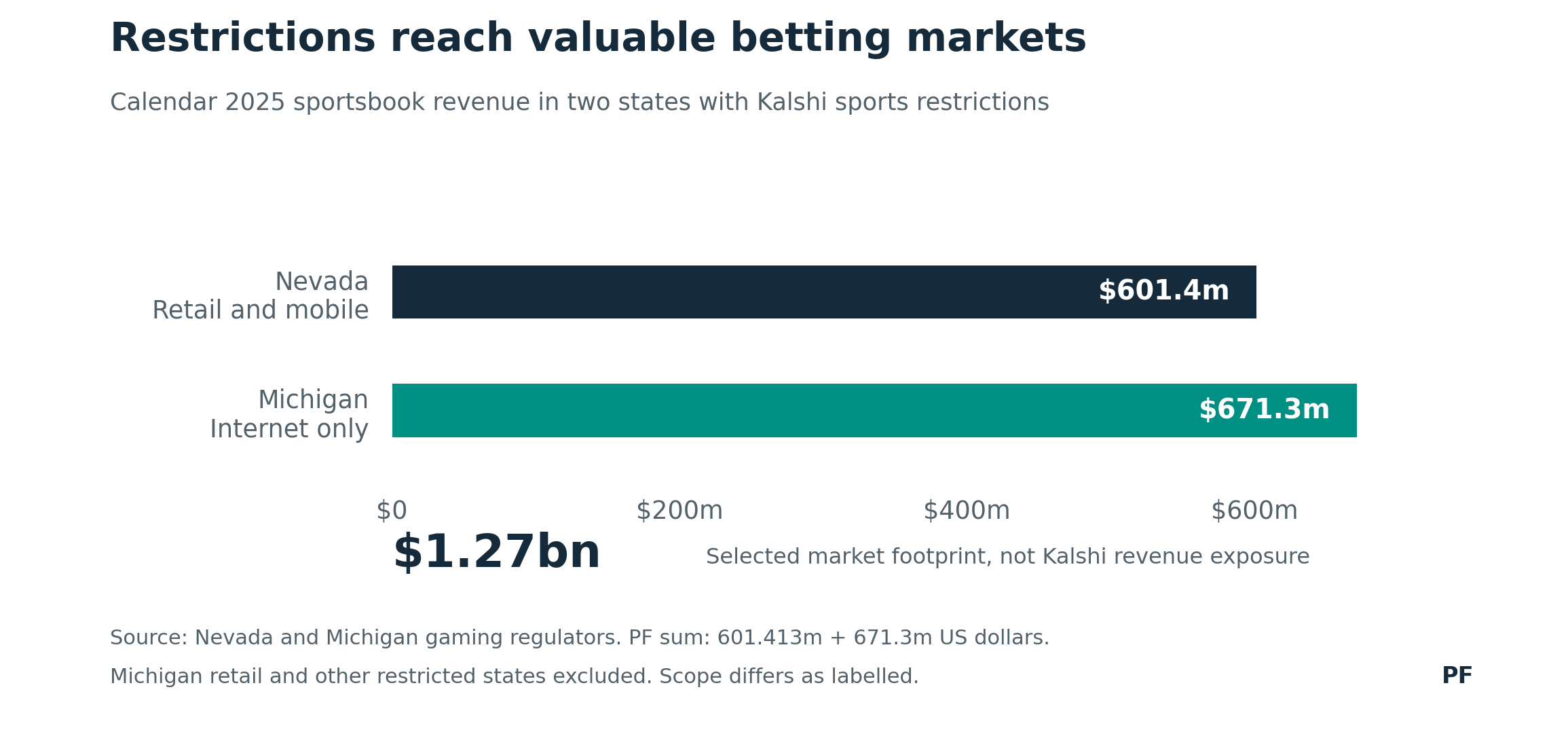
A count of affected states would miss that commercial weight. It would also miss a distinction in the other direction: losing access to a state with few legal sportsbook alternatives could matter more to an exchange than historical sportsbook revenue suggests. The missing number is each platform's own funded customers and retained fees by state.
The CFTC continues to defend federal jurisdiction through litigation and rulemaking. Its October interim final rule excluded casino-style gambling products from the swap definition; a separate proposal would expressly include event contracts covering sports and other subjects. That inclusion is still proposed. [18][19]
The Supreme Court has not granted review in New Jersey's case. Its docket gives Kalshi until 7 December to respond. If the Court eventually allows state enforcement against the sports contracts at issue, the consequences will depend on the ruling's scope. Platforms may need licences or partnerships in some states and have to restrict service in others. Permitted financial contracts could remain available. [2]
A US customer could take longer to pay back
State licensing would first have to be legally available for the exchange's model and contracts. Where it is available, local taxes, distribution payments and product restrictions could change what the operator retains from each customer.
New York's 51% tax on mobile sportsbook gross gaming revenue illustrates how substantial an existing state framework can be. It does not establish that an exchange would face the same tax rate or tax base. That treatment would have to be settled for the actual product. [20]
Operators are already paying affiliates for customers. Better Collective's Publishing CPA revenue rose 93% year on year to €6.95 million in Q3, from €3.60 million. Management attributed the growth to North American prediction-market partners, where it says agreements are mainly structured on a cost-per-acquisition basis. The total covers all Publishing CPA revenue and does not reveal any exchange's acquisition cost per customer. [21]
The acquisition problem can arise even if advertising prices stay the same. Suppose an operator spends $120 to acquire a funded customer who generates $20 of monthly contribution after variable costs. Simple payback takes six months. If the operator retains $10 instead, it takes twelve. Losing lawful access after month eight leaves $40 of that acquisition spend unrecovered in the second case.
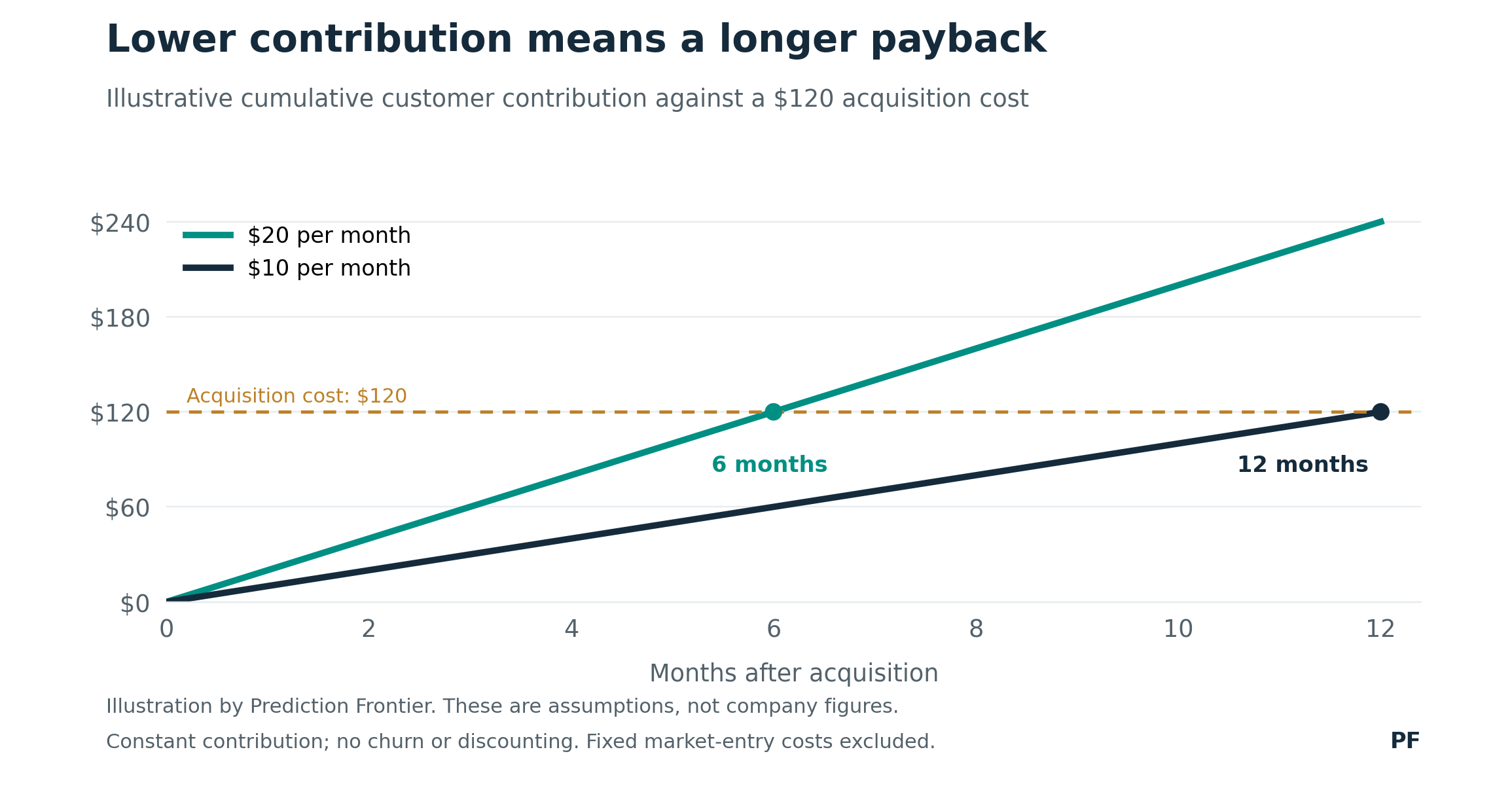
The marketing invoice has not increased. The amount the business can afford to pay for that customer has fallen. A platform would need cheaper acquisition, stronger retention or more contribution to restore the original economics.
Licence fees and fixed compliance spending belong in the market's operating budget. They should be assessed alongside acquisition spending without being relabelled as advertising costs. A country with cheap signups may still be expensive to serve; a country with higher acquisition costs may justify them through repeat trading.
Operators therefore need to compare customers over the period they expect to retain and lawfully serve them. Public disclosures do not yet establish whether an overseas trader offers better economics than an American one. They do establish why platforms should be collecting that evidence before a court decision makes it urgent.
Where the customers are remains harder to establish
The most accessible geography data measures attention. Similarweb estimates that the US supplied 87.67% of desktop traffic to Kalshi.com in October, against 28.56% for Polymarket.com. Brazil accounted for 12.92% of Polymarket.com's traffic, followed by Canada at 4.50% and the UK at 4.01%. [22][23]
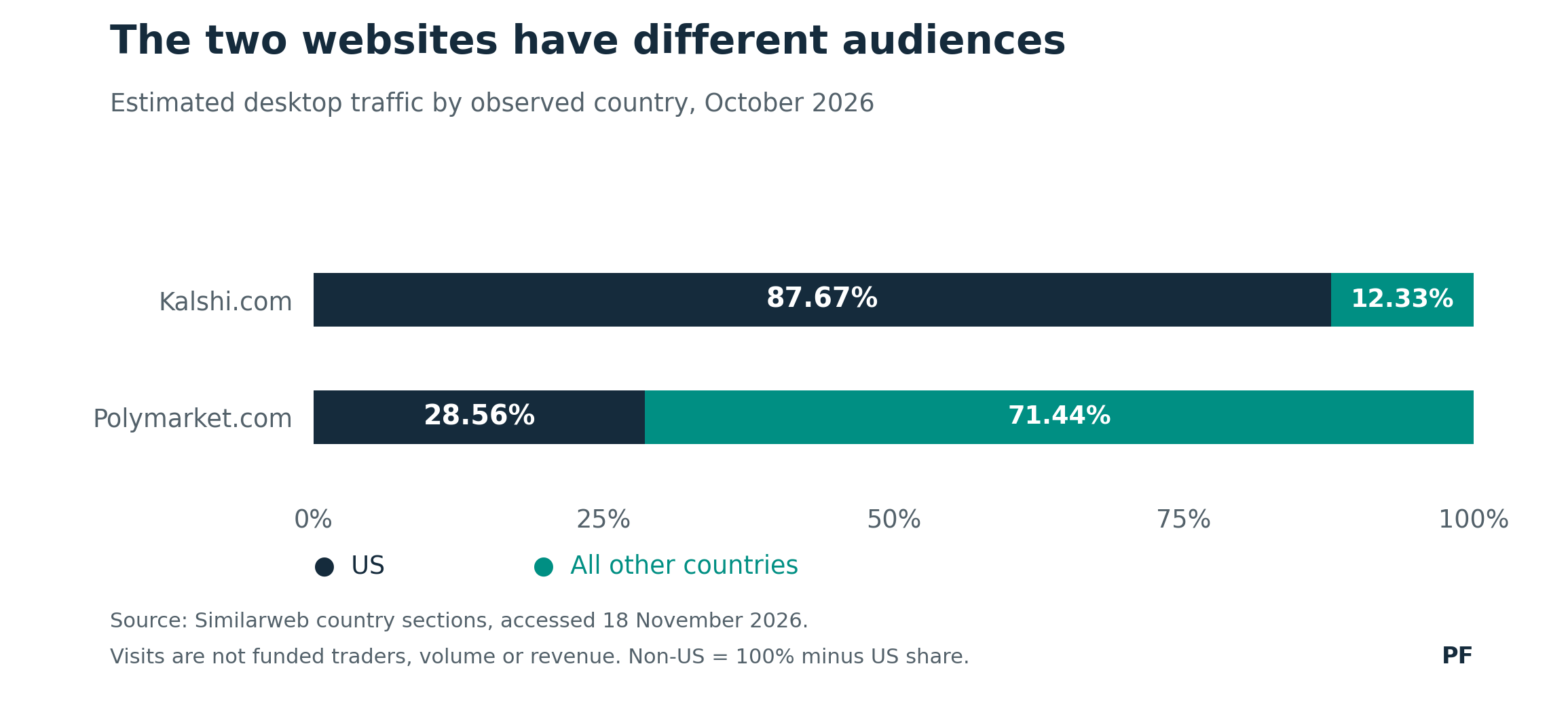
Someone checking an election probability may never fund an account. A brokerage customer may trade without visiting the exchange website. Apps and APIs fall outside this comparison, and VPNs can distort observed location.
Brazil shows the danger of treating attention as an addressable market. Its substantial Polymarket audience coexists with April government action blocking prediction platforms and restrictions on derivatives tied to sports, politics and entertainment. [24]
Brazil's wider betting industry was then hit by a provisional measure dated 25 September prohibiting fixed-odds sports betting and online gaming, including related advertising. [25] Better Collective estimated a €15 million revenue hit for the rest of 2026. [21] That estimate concerns its wider betting business, not prediction markets alone. Overseas expansion can reduce exposure to a US court defeat while introducing policy risk elsewhere.
Exchange data answers a different question. Pew found that Polymarket US's share of combined Polymarket trading rose from 4% in January to 39% in July. That measures activity on a legal venue, rather than the home country of every trader. Nor would trading a European football contract establish that the customer was European. [7]
Volume also leaves the revenue question open. Prediction Frontier recorded $179.6 billion of notional contract volume and $56.1 billion of purchase payments across four tracked venues in Q3. Neither figure measures unique capital or operator income. [26]
Kalshi's October disclosure is more useful for assessing the overseas business: international retail trading fees approaching a $100 million annual run rate after expansion to more than 140 countries. It is a company-reported run rate, with no country breakdown or matching acquisition and servicing costs. It demonstrates fee generation without establishing where expansion is most profitable. [3]
An operator choosing its next market needs funded active customers by residence, fees retained after incentives and distributor payments, and evidence of repeat trading. Until those figures are available, a global traffic chart can help identify questions to investigate. It cannot rank the best markets to enter.
A licence gives the operator a home
Gibraltar's Prediction Market Regulations date from July. Its public register lists Predict Street Limited and Wire Alternative Markets Limited as authorised operators. Nevis introduced its dedicated category on 30 October, covering both consumer operators and business suppliers. [27][4][5]
| Jurisdiction | Published licence charges | Additional requirement or charge |
|---|---|---|
| Gibraltar | £30,000 application and £100,000 annually | Duty of 0.15% of commission charged. [28] |
| Nevis | €18,000 setup and €18,000 annual renewal | Further application and operating costs may apply. [29] |
| Liberia | $80,000 prediction-market operator licence | $500,000 minimum paid-up capital for that class; other charges apply. [30][31] |
Gibraltar
Published licence charges: £30,000 application and £100,000 annually
Additional requirement or charge: Duty of 0.15% of commission charged. [28]
Nevis
Published licence charges: €18,000 setup and €18,000 annual renewal
Additional requirement or charge: Further application and operating costs may apply. [29]
Original currencies. Published charges are not comparable all-in launch budgets. Required capital is distinct from a fee or operating expense.
For a prospective operator, these regimes offer a place to establish the business and a defined supervisor. Banking, payments and distribution partners still have to accept the arrangement. The customers it can serve depend on the destination market.
Nevis's authority makes that limit explicit: its authorisation remains subject to the laws and regulatory requirements of jurisdictions where services are offered. A licence there does not settle the treatment of a customer in Britain, France or a US state. [5]
This matters particularly to smaller entrants comparing headline licence prices. The cheaper permission may leave the harder work untouched: obtaining access to customers, moving their money and supplying contracts they return to trade.
Overseas opportunities favour different business models
Canada offers one example of how expansion can work through a local intermediary. Wealthsimple's documentation describes access to Kalshi through its regulated Canadian brokerage, with contracts covering financial metrics, economic data and climate. Its June announcement described approval for contracts settling over periods of at least 30 days. [32][33]
Wealthsimple holds the customer relationship and custody arrangements; Kalshi supplies exchange access. For an exchange, a distributor can bring customers it would otherwise have to acquire individually. The trade-off is a narrower catalogue and economics that must support both businesses. A sports-heavy US product cannot simply be copied into that channel.
Media can also supply distribution. On 18 November, Better Collective said Kalshi and Novig had received a six-figure number of trades through Playbook since their mid-October integration. It connects sports content with markets and pre-loaded selections. That is a company-reported trade count, with no customer count or dollar volume disclosed. [34] A local publisher could offer an overseas entrant a similar route to an audience, subject to destination-market permissions.
Great Britain offers an established gambling route. The Gambling Commission says current prediction-market models appear to fit betting-intermediary licensing, depending on their design. Betting exchanges have operated there since 2000, and consumers already have broad access to sports betting. [35]
An entrant needs a reason for those customers to switch or add another account. Useful contracts, better execution or an existing distribution channel could supply one. A locally licensed sportsbook might have an advantage in reaching customers and handling payments, but would still need permission for the proposed product and an exchange people want to use.
Treating contracts as financial instruments does not necessarily open more doors. ESMA says qualifying event contracts can fall within national measures prohibiting retail distribution of binary options. Non-retail distribution still requires investment-firm authorisation. France's blocking of Polymarket, ASIC's statement that no prediction-market operators are licensed as financial markets in Australia, and Singapore's prohibition on unlicensed remote gambling further limit any broad claim of overseas availability. [36][37][38][39]
African opportunities need the same country-level assessment. Liberia has a defined route through a prediction-market operator licence or a board-ratified partnership. Its rules prohibit contracts on a named person's death, criminal activity and Liberian election outcomes. The $500,000 capital requirement makes this a meaningful commitment for an early-stage operator. [30]
Kenya is earlier in the process. In an October Business Daily interview, Gambling Regulatory Authority director general Peter Karimi described plans for a prediction-market licence class and treated the activity as gambling. That is evidence of regulatory intent, rather than an issued dedicated authorisation. [40]
For a smaller builder, the opening may be one permitted local product, practical deposits and withdrawals, and a distributor that already reaches the intended customer. Contracts on local economic releases or sports would need reliable settlement data and enough counterparties to make trading worthwhile. A large population of sports fans, on its own, supplies neither.
Suppliers have another route. Technology, settlement data and surveillance can be sold to locally authorised operators without owning the consumer relationship. That business would depend on fewer commercial customers and bring its own regulatory obligations, but it deserves consideration alongside the expense of acquiring retail traders directly.
The overseas business must survive a US shock
Customer acquisition is only half of an exchange's problem. Someone must quote the other side at a price the new customer is willing to accept. A low acquisition cost loses much of its value if the trader arrives at an empty order book.
Where US and overseas participants trade the same contracts, international revenue may still depend on American liquidity. Losing US activity could reduce depth or widen spreads, making the product less useful abroad. That is a risk to test with order-book data, rather than an outcome that follows automatically from a state's restriction. Geofencing does not itself require a separate pool for everyone else.
Local contracts need their own assessment. Active American sports markets do not guarantee counterparties for an African inflation release or a European weather outcome. The operator may have to pay market makers before customer fees can support that cost. Overseas expansion can spread legal risk while adding another bill.
A large exchange can fund US litigation alongside selected broker partnerships and overseas products. A smaller entrant has more reason to concentrate its resources where permission, distribution and a useful catalogue can come together. Local incumbents can contribute customer access; suppliers can build businesses serving them. Those are different opportunities, with different capital needs.
Before committing more money, an operator should be able to show which countries supply funded customers and how many return after incentives end. Their fees need to cover payment costs, partner shares and the cost of maintaining usable markets, with enough left to repay acquisition spending and support local operations. An overseas business that can do that would be valuable even if the platform wins in the US courts.
The US opportunity justifies defending the business. It also gives platforms a reason to start this work while they can still choose the pace. If a court defeat eventually forces expansion, permissions, distribution and liquidity will all be needed before the replacement revenue arrives. They take longer to build than an international launch announcement.
Sources
- Fourth Circuit. KalshiEX v Martin opinion. 17 November 2026.
- US Supreme Court. Docket 26 299 New Jersey v Kalshi. Checked 18 November 2026.
- Kalshi. Series G announcement and business disclosures. 29 October 2026.
- Gibraltar Gambling Division. Prediction market authorisation register. Checked 18 November 2026.
- Nevis Online Gaming Authority. Prediction market licence launch. 2 November 2026.
- American Gaming Association. State of the States 2026. 12 May 2026.
- Pew Research Center. Sports trading and prediction market volumes. 23 September 2026.
- DraftKings. Third quarter results and Predictions guidance. 5 November 2026.
- Third Circuit. KalshiEX v Flaherty opinion. 6 April 2026.
- Ninth Circuit. KalshiEX v Assad opinion. 28 August 2026.
- Sixth Circuit. KalshiEX v Schuler and Orgel consolidated opinion. 25 September 2026.
- Michigan Ingham County Circuit Court. Order granting preliminary injunction against Kalshi. 1 September 2026.
- Nevada First Judicial District Court. Joint stipulation and geolocation order. 24 July 2026.
- Washington King County Superior Court. Amended order granting preliminary injunction against Kalshi. 12 August 2026.
- CFTC. Louisiana litigation announcement. 13 November 2026.
- Nevada Gaming Control Board. December 2025 Gaming Revenue Report. 26 January 2026.
- Michigan Gaming Control Board. December and calendar 2025 internet gaming and sports betting results. 21 January 2026.
- CFTC. Interim final rule excluding certain activity from swap definition. 9 October 2026.
- CFTC. Proposed inclusion of event contracts in swap definition. 9 October 2026.
- New York State Gaming Commission. Statewide sports wagering report. Checked 18 November 2026.
- Better Collective. Q3 2026 report pages 6 9 and 17. 18 November 2026.
- Similarweb. Kalshi website traffic geography. October 2026.
- Similarweb. Polymarket website traffic geography. October 2026.
- Brazil Agência Gov. Government prediction-platform blocking action. 24 April 2026.
- Brazil Ministry of Finance. Guidance on Provisional Measure 1394 of 2026. Updated 7 October 2026.
- Prediction Frontier. Prediction market statistics Q3 edition. 20 October 2026.
- Gibraltar Laws. Prediction Market Regulations 2026 listing. 13 July 2026.
- Gibraltar Laws. Prediction Market Fees and Duties Regulations. 13 August 2026.
- Nevis Online Gaming Authority. Published licence fees. Checked 18 November 2026.
- Liberia National Lottery Authority. Revised Regulation 005 of 2026. Adopted 29 April 2026.
- Liberia National Lottery Authority. Revised fee schedule under Resolution 005. 2026.
- Wealthsimple. How Wealthsimple Predict works. Updated 1 November 2026.
- Wealthsimple. Prediction markets launch announcement. 18 June 2026 dateline.
- Better Collective. Playbook expansion through Kalshi and Novig integration. 18 November 2026.
- UK Gambling Commission. Prediction markets regulatory position. 4 February 2026.
- ESMA. Event contracts and binary option measures. 3 July 2026.
- France ANJ. Polymarket website blocking. 17 July 2026.
- ASIC Moneysmart. Prediction markets warning. Updated 11 November 2026.
- Singapore GRA. Unlawful remote gambling activities. Checked 18 November 2026.
- Business Daily. Interview on Kenyan prediction-market regulation. 18 October 2026.
- US District Court, Southern District of New York. New York v KalshiEX, opinion and order remanding the enforcement case. 19 November 2026.