How Prediction Markets Traded the 2026 US Midterms
Kalshi and Polymarket traded $2 billion in 2026 US midterm contracts. Kalshi priced both chambers at 99% for Democrats about two hours before NBC News called them.
Election brief by Lujan Odera · 6 November 2026
Executive summary
Kalshi reached 99% before NBC’s calls. Kalshi priced Democratic control of each chamber at 99% about two hours before NBC News called it. By 6am Eastern on 4 November, Kalshi’s favourites had won 479 of 487 resolved races.
About 75% of measured volume came from 20 October onward. Kalshi and Polymarket traded $2.0 billion in midterm contracts from 5 January to 4 November. The 24 hours from 4pm Eastern on election day accounted for $794 million.
The Senate market got deeper. On Polymarket, $100,000 of net daily buying moved the Democratic Senate contract by 3.2 cents through 18 October and by 1.7 cents through election eve.
The largest Polymarket position was a hedge. On 11 October, a $3.43 million holding on a Democratic sweep consisted of matched Yes and No shares. The largest single-position profit among Polymarket politics positions resolved on 3–4 November was $3.05 million and went to a wallet outside the top 20 midterm holders on 11 October.
Download the full midterms report (PDF, 8 pages) · Download the election brief (PDF, 2 pages)
How the markets priced the election
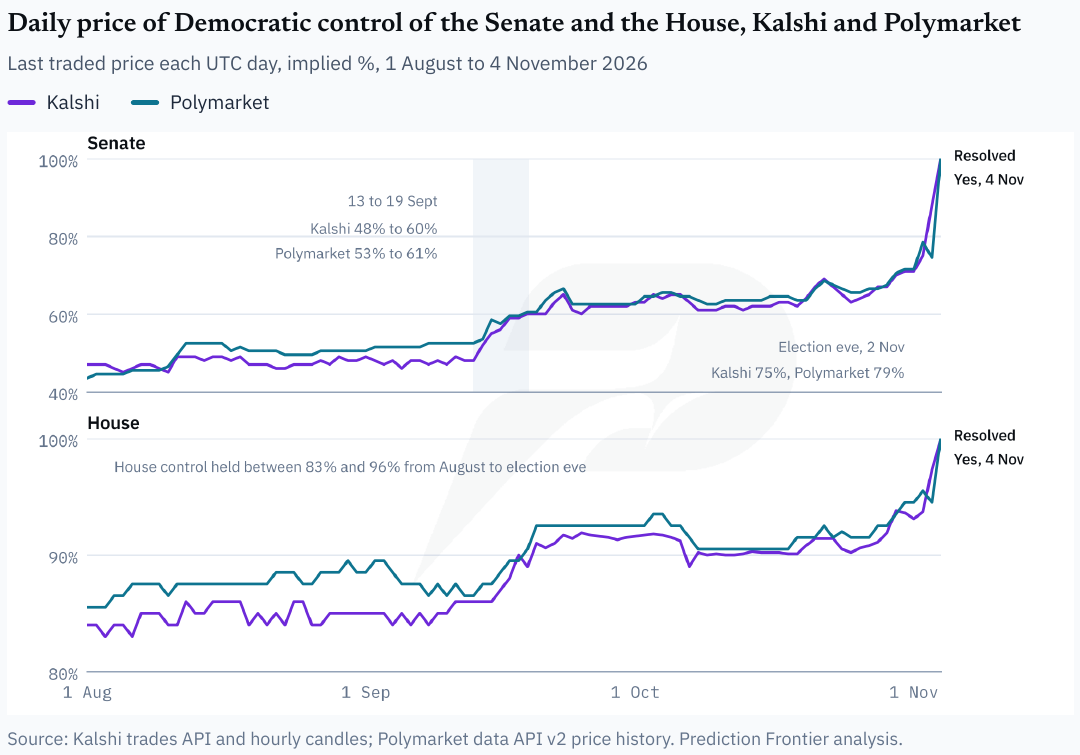
Democrats won both chambers on 3 November. Kalshi’s Democratic Senate contract opened at 18 cents after the 2024 election, first crossed 50 cents in mid-March and fell back to 41 cents by late June. It reached 60 cents in a single week in September and was near 75 cents on the afternoon of election day.
On both Kalshi and Polymarket, the price of a Democratic sweep went from 75% at 6pm Eastern to 89% at 7pm and 98% by 9pm. Kalshi’s House contract hit 99% at 8:10pm and its Senate contract did the same at 9pm. NBC News called the House at 10:08pm and the Senate at 11:26pm.
By 6am Eastern on 4 November, Kalshi’s favourites had won 479 of the 487 races the exchange had resolved. South Carolina was the biggest miss in the brief. Annie Andrews traded at 30.5% on Polymarket an hour before polls closed and won by 4.4 points.
One night out-traded the first 41 weeks
From 5 January to 18 October, midterm markets traded $502 million. The 15-day window ending at 4pm Eastern on election day added $708 million, and the next 24 hours added $794 million. About three quarters of measured volume came from 20 October onward. Kalshi accounted for $1.53 billion of the total and Polymarket for $474 million. Kalshi took 88% of results-night volume, up from 69% through mid-October.
Texas out-traded the Senate control market
Kalshi’s Texas Senate market traded $187 million by 4 November. Its Senate control market traded $115 million. Texas finished within $20 million of the House control market, and Democrat James Talarico won the seat.
Four of every five dollars on Kalshi’s ten largest midterm markets traded after 21 October. Florida’s governor race went from $3.5 million by 21 October to $44 million by 4 November, a twelvefold rise in a race Republicans held.
The Senate market got deeper
We used 284,000 trades on Kalshi and Polymarket from 1 August onward to estimate how far prices moved per $100,000 of net daily buying. The method reproduced Dune’s curated Kalshi results to within 0.02 cents.
Through 18 October, $100,000 of net daily buying moved Polymarket’s Democratic Senate contract by 3.2 cents. By election eve, the same amount moved it by 1.7 cents. Cash traded on that contract grew from $1.9 million to $6.8 million over those windows and reached $14.4 million by 4 November. On Kalshi, the estimated impact on the Senate contract fell from 1.5 cents to 0.6 cents. The House control contract moved about 0.2 cents per $100,000 on Kalshi. The price-impact analysis stops at election eve because prices on results night moved on vote counts.
Polymarket’s biggest October position was a hedge
On 11 October, the largest Polymarket midterm position was rdba’s $3.43 million holding. The wallet (0xc4d1…8ce8) held matched Yes and No shares on a Democratic sweep, a pair that pays exactly $1 regardless of the result. It earned $10,807 in holding yield in September and $7,772 in October before closing the position on 25 October.
rdba earned $749,250 on its separate House control position. The largest single-position profit among Polymarket politics positions resolved on 3–4 November was $3,051,614 on a Democratic sweep. It went to ndb1, a wallet outside the 20 largest midterm holders on 11 October. The brief PDF has the full five-position table.
How stock perpetuals traded the result
The S&P 500 perpetual on Hyperliquid was down 1.3% at 9pm Eastern, then recovered to close 4 November up 1.6%. Vistra fell 13.9%, IREN 11.2% and CoreWeave 10.6%. Microsoft rose 7.1% and Amazon 6.2%. Tesla perpetuals traded 6.5 times their usual overnight volume.
Three races were still open
As of 4 November, Mary Peltola led Alaska’s Senate race by about 626 votes, with the ranked-choice count due on 18 November. Scott Colom led Mississippi’s Senate race by 43 votes, with no automatic recount, and Democrat Cindy Holscher led the Kansas governor’s race by about 5,557 votes. The markets remained open pending race calls.
Method and sources
Volume is taker-side notional, counting each contract at its $1 payout value. The volume series uses Dune queries 8931744 and 9075861 and the Kalshi and Polymarket APIs. The measured windows leave a 44-hour gap on 19–20 October. Individual race-market volumes run through the end of 4 November Eastern.
Event volumes, trades and prices come from the Kalshi trade API and Polymarket data API v2. Price impact is an ordinary least squares fit of daily price changes on daily net taker flow. Wallet analysis uses Polymarket’s activity records and politics leaderboard, with the 11 October holder snapshot from Dune query 8931953.
Call times are from NBC News. The race tally is from Kalshi’s midterms recap. CryptoTicker supplied the Polymarket price for South Carolina. Stock perpetuals data comes from Hyperliquid via Dune queries 9069177 and 9070461. Data was retrieved on 5–6 November 2026.
For the pre-election picture, read PF Weekly’s October analysis of the US midterm markets. The Q3 2026 sector report explains the difference between contract volume and cash traded.