The 12¢ comeback in Rio: How prediction markets went crazy during NFL’s ‘Game of the Year’
Weekly Sports Round Up, Edition 02. What the prediction markets did during the NFL's first game in Brazil and the first week of the FIFA window, read for traders and institutions.

Weekly Sports Round Up, Edition 02. Four charts from our trade-level data on the NFL's first game in Brazil and the first week of the FIFA window.
At 7:37 p.m. ET on Sunday, a $100 bet placed on the Ravens to win would have paid out $850 on Polymarket seven minutes later.
Data from Polymarket's API was lined up against Kalshi's prices and other exchanges to deeply analyze how prediction markets reacted to what was a “Game of the Season” contender in Rio.
With under half a minute left in Rio, the Ravens traded at 12¢ on Polymarket. About seven minutes of real time later, Tyler Loop's 56-yard kick sent the same contract to 99¢. The same week, Europe's big leagues paused and soccer trading fell by more than half. Four charts built from every trade behind both stories show what the money did.
This is Prediction Frontier Sports, a weekly read on how sports trade in prediction markets, written for traders and for the institutions watching them. Each week we will tell interesting stories in sports markets, analyze the market trade by trade, and make calls on what we expect the coming week to look like.
Nine real minutes decided Rio, and Kalshi priced the finish three seconds faster
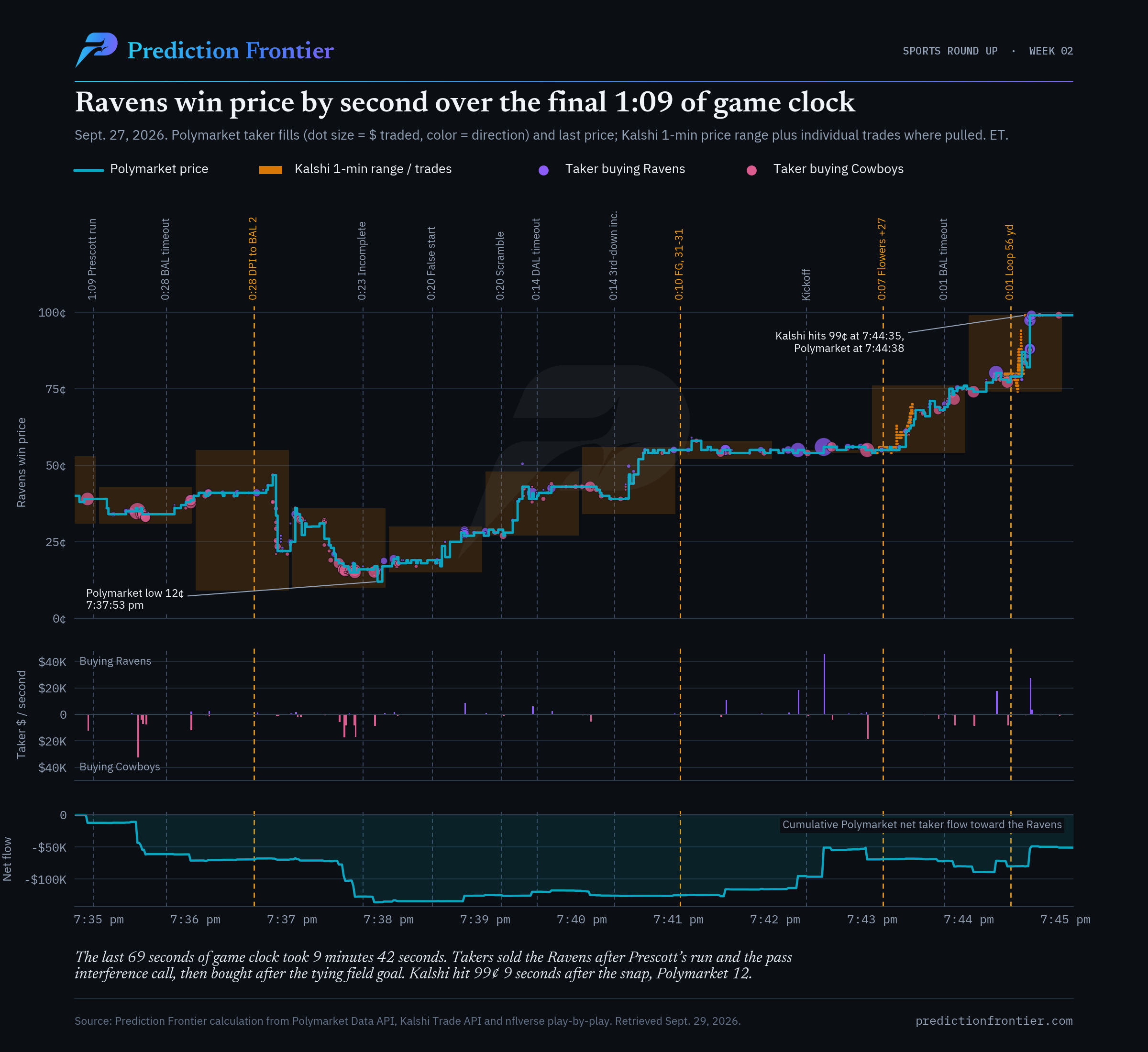
The last 1:09 of game clock took 9 minutes 42 seconds of real time, and the chart shows every Polymarket fill in that stretch as a dot, with a running total of taker money toward each team in the bottom panel.
Sellers and price bottomed together. Net flow toward Dallas peaked at $123,682 at 7:37:53 p.m., the same second the Ravens printed 12¢ after a pass interference flag. Buyers returned before the finish, including a $45,358 fill on the Ravens at 56¢ with the game tied. Kalshi then reached 99¢ nine seconds after Loop's snap, and Polymarket took twelve.
Three seconds is a long time in a market. Who captured it?
Market makers nearly tripled their presence as the game tightened
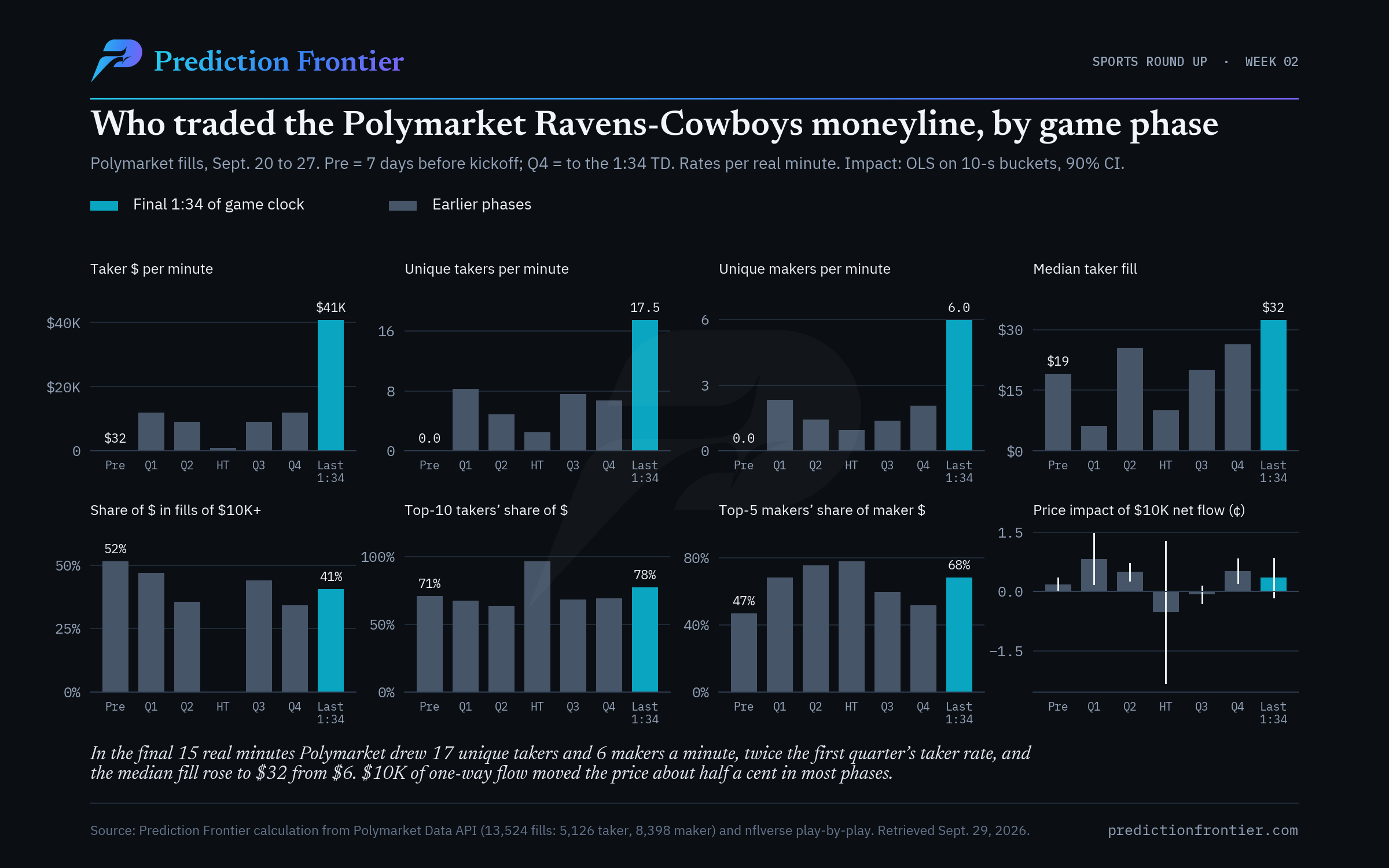
The game was split into phases, and we captured that by measuring who traded per real minute. As the chart above shows, the final sequence taker money ran at $40,686 a minute, against $11,954 in the first quarter. Unique makers went from 2.3 a minute to 6.0, and the median taker fill went from $6 to $32.
Prices absorbed the rush. At the end, $10,000 of one-way flow moved the price about 0.36¢, against 0.83¢ in the first quarter. The catch is concentration: the ten largest takers put up 78% of final-sequence dollars.
Take the clubs away and soccer trading falls by more than half
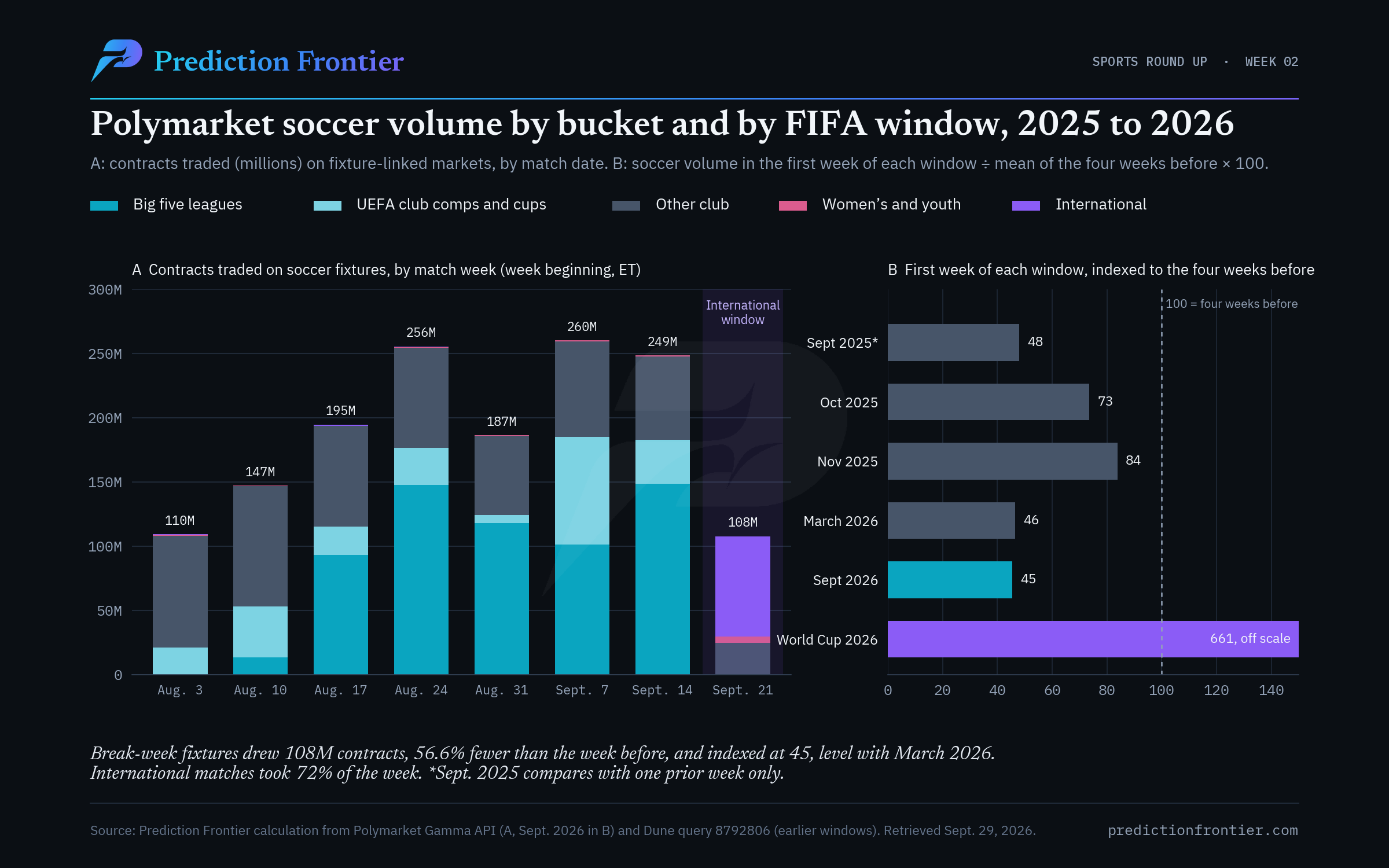
The big five leagues carried between 100M and 150M contracts a week before the break and none in the week of Sept. 21, while internationals jumped to 78M. That was 72% of the week, yet the total still fell 56.6% to 108M.
This international friendlies window was ranked high in our index (which compares the first week of the international break’s volumes to the prior four weeks), scoring 45 against the four weeks before it, level with March 2026 (46) and deeper than October 2025 (73) or November 2025 (84). The World Cup group stage scored 661. Only a World Cup moves national-team money on that scale.
Only 16% of club-soccer traders followed the game to national teams
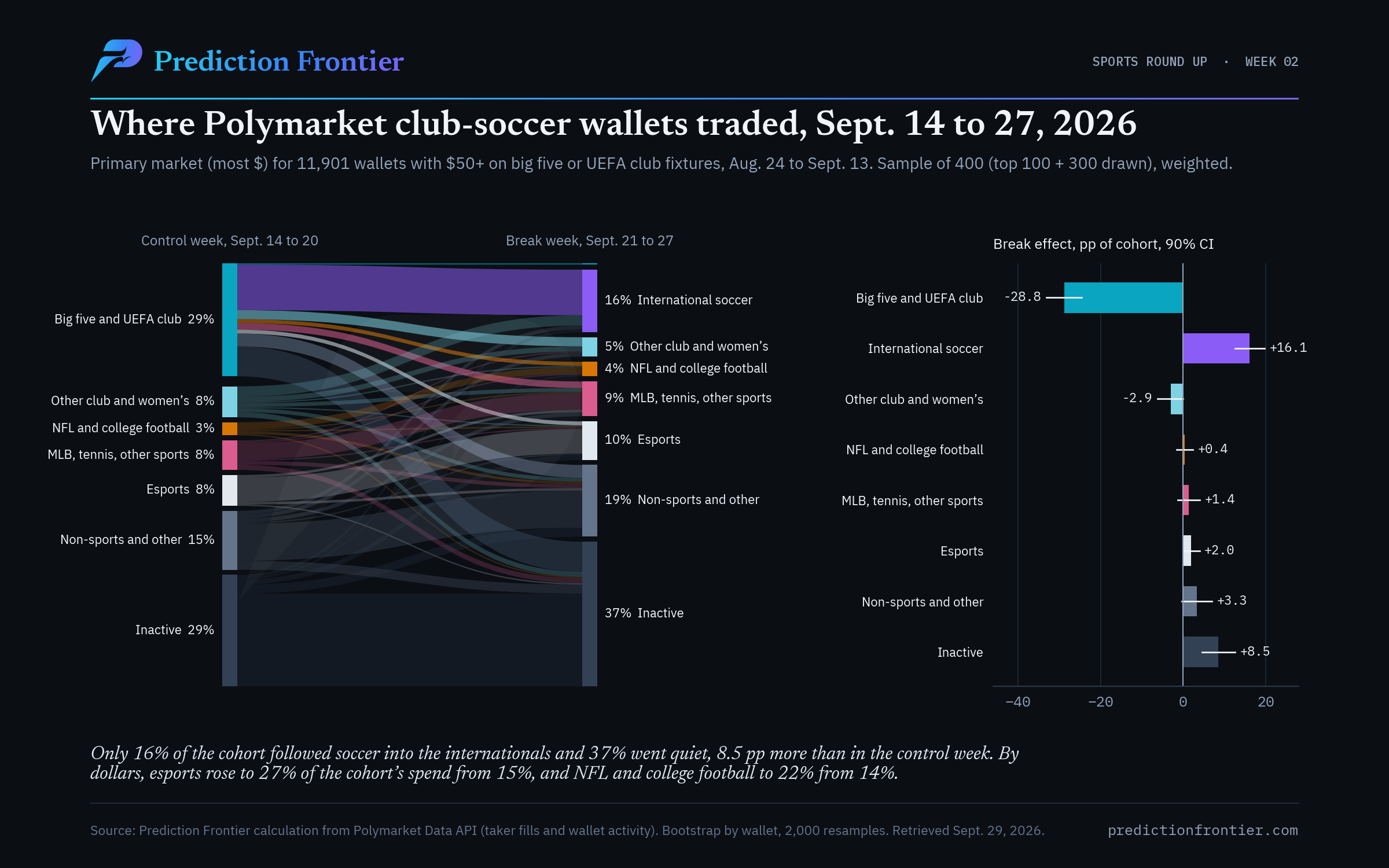
We tracked 11,901 wallets that traded Big Five European leagues or UEFA club fixtures before the break and plotted where each did most of its trading: the week before the window on the left and the first week of it on the right.
Only 16% made internationals their main market, and 37% did not trade at all, 8.5 points more than the week before. The dollars moved further. Esports rose to 27% of the cohort's spend from 15%, and the NFL and college football rose to 22% from 14%. DeFi Rate has Polymarket's international exchange, where these wallets trade, down 13.5% for the week, while Kalshi set a record at $15.66B.
Outside the data, the Sixth Circuit ruled against Kalshi in Ohio and Tennessee, and New York sued Polymarket US for at least $4.6B. The Block, Front Office Sports, DeFi Rate
Next Week’s Predictions?
For next week’s edition, we expect Polymarket soccer fixtures to trade fewer than 143M contracts in week two of the international break. We also expect soccer volume to stay below 60% of its club-season level through the second week of the window, and at least one NFL Week 4 game to beat the Panthers at the Browns as the season's most volatile.
Download full report here.
Prediction Frontier publishes data for information only; nothing here is investment, trading or betting advice. |