Prediction Market Leverage: Jump Risk and Financing Costs
Why binary event-contract prices can jump through liquidation levels, how lenders price that risk, and the assumptions behind the fair-fee argument.

Scope updated 23 October 2026: this is a model-based discussion of binary-contract jump risk, not a current inventory of venue margin products. The illustrations simplify price paths; other financial assets can also gap.
In Part I of the Prediction Markets: Intelligence Series, we discussed How Prediction Markets Work — And Why They’re Smarter Than Any Single Expert, a piece that digs deep into what prediction markets are all about and how they help shape decisions, and gives the best impression of what the market looks like.
In Part II of this series, we talk about leverage in Prediction Markets. We discuss the case for and against leverage on PMs. Is it possible to have leveraged betting markets? Why is it difficult to price leverage fees? What are the solutions that could help grow leveraged prediction markets?
This article examines financing a binary position when a jump can bypass liquidation. The outcome depends on the model, collateral, fees and legal permissions.
This piece is inspired by the nice work of the Messari researcher, Kaleb Rasmussen, in his research paper, Enabling Leverage on Prediction Markets.
Why binary contracts are difficult to finance
Prediction markets have spent the past five years quietly proving something profound: when people are allowed to bet on outcomes, prices become forecasts. Not opinions, not narratives — probabilities.
Prices can respond as participants trade on new information. Financing those positions creates a separate question: who bears losses if the price moves faster than collateral can be recovered?
And yet, for all their apparent sophistication, prediction markets remain structurally incomplete.
The fully collateralised retail binary model considered here requires the purchase price upfront.
In traditional finance, leverage is not an optional feature — it is the mechanism that allows informed participants to scale conviction. It is what transforms a correct insight into meaningful profit, and more importantly, into price impact. Without leverage, even the most accurate trader is capital-constrained.
The problem arrives the moment you try to engineer a financing structure around a binary instrument, and it arrives with unusual mathematical brutality.
A conventional margin model often assumes time to liquidate after a threshold is breached. Equities and crypto can also gap, so continuous movement is an assumption rather than a universal property. A position that moves against a leveraged trader triggers a margin call. The margin call triggers liquidation. Liquidation happens at a price close enough to the margin threshold that the financier — the entity providing the leverage — recovers most or all of the exposure.
So why hasn’t leverage emerged naturally in prediction markets?
This article concentrates on financing. It does not establish that regulation, market structure or technology is irrelevant.
So what exactly are we talking about?
Imagine you spot a market that is currently trading ‘YES’ shares at 92 ¢ — implying a 92% probability the event does occur — this appears safe by any conventional risk metric. However, deep within the architecture of the trade, obscured from conventional risk models, lies a structural fact that fundamentally distinguishes prediction markets from every other leveraged instrument in finance: the reality that this outcome can collapse from near-certainty to zero in less time than any margin engine on earth can execute a liquidation.
Therein lies the fundamental problem with leveraging prediction markets: a single concept known as jump risk. Not only that, but for binary prediction markets, fairly priced leverage may be fundamentally useless.
The capital-efficiency argument for leverage
To understand why leverage matters, consider the basic payoff structure of a prediction market.
A contract priced at 70¢ implies a 70% probability of occurring. If the event resolves “YES,” the payoff is $1. If it resolves “NO,” it is $0.
This creates an asymmetry that is easy to overlook but critical in practice:
You risk 70¢
To win 30¢
Even if you have a strong informational edge, your upside is capped relative to your capital deployment.
For a retail trader, this may be acceptable. For an institutional participant, it is prohibitive.
a. The Capital Constraint Problem
In equity or derivatives markets, leverage allows a trader to express a view without tying up the full notional value of the position. A hedge fund that believes a stock is undervalued does not deploy 100% of its cash — it borrows against collateral, scales the position, and amplifies the signal.
That is not available within the fully collateralised purchase model discussed here; other products require their own terms and risk analysis.
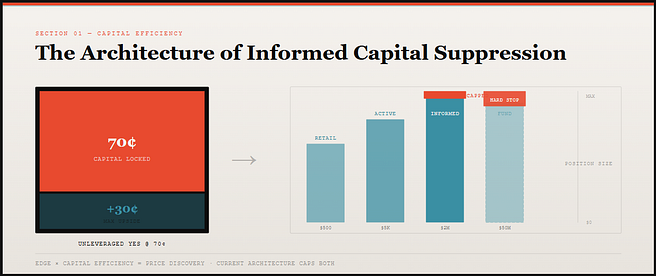
Retail vs Institutional need for leverage in prediction markets
A trader who believes a 70¢ contract should be 85¢ cannot efficiently size that conviction. The capital required to express the view increases linearly, while the payoff remains bounded.
The result is structural under-participation by the very actors that prediction markets are designed to attract: informed, well-capitalized traders.
b. The Hedging Argument
This limitation extends beyond speculation.
Prediction markets are, in theory, the most natural hedging instruments for event risk:
A company is exposed to regulatory approval
A fund exposed to election outcomes
A macro portfolio sensitive to central bank decisions
These are not price risks. They are binary or quasi-binary outcomes.
Traditional derivatives markets struggle to price these events directly. Event contracts can isolate some of these outcomes. Their usefulness at scale also depends on executable depth, basis risk and suitable contract design.
c. The Liquidity Feedback Loop: Price Accuracy
There is also a second-order effect: liquidity.
Leverage attracts market makers. Market makers tighten spreads. Tighter spreads improve price accuracy. More accurate prices attract more participants.
This is the same feedback loop that transformed crypto perpetual futures into trillion-dollar markets.
Prediction markets have proven they can aggregate information. What they have not yet proven is that they can do so at an institutional scale.
Leverage is the missing mechanism.
Jump risk and financing costs
The argument for leverage is intuitive, almost obvious.
The argument against it is not.
It comes from a deeper examination of how binary markets behave under stress — an analysis most clearly articulated in the Messari research by Kaleb Rasmussen.
At the center of that analysis is a single claim:
Binary prediction markets are not continuous systems. They are discontinuous. And discontinuity breaks leverage.
a. The Nature of Jump Risk
Previously, we briefly explained what jump risk is. In equity markets, prices move (mostly) continuously. Even during volatility, there are intermediate price points. This allows liquidation engines to function:
Positions can be partially unwound
Collateral can be adjusted
Losses can be contained
Binary markets do not behave this way. They “jump.” A contract trading at 92¢ can go to 0¢ in seconds if new information resolves the outcome. There is no glide path. No gradual decline. No opportunity to liquidate.
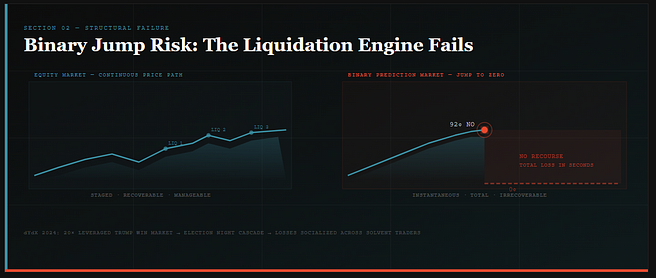
A clear look at how jump risk affects financiers in leveraged PMs.
A financier must correctly price jump risk and charge fees that reflect the full expected value of that risk. And because binary prediction markets are, by definition, zero-sum — the probability of a jump to one and the probability of a jump to zero sum to one — the expected loss from jump risk, properly priced, exactly offsets the expected return of the leveraged position (Read more in Kaleb Rasmussen’s paper for equations). The result is conditional: in the instantaneous-resolution model, a fair financing fee can remove the leverage benefit relative to an unleveraged position. The fees necessary to price the risk consume the expected return from having leverage in the first place.
b. The Zero-Upside Proof
It is important to state this idea clearly, because it is frequently misunderstood. The claim is not that leverage is risky — all leverage is risky. The claim is that binary markets, unlike scalar markets or equity markets, have a structural property that makes the actuarially fair price of leverage equal to the leverage’s benefit.
You cannot build a product that enables more efficient capital deployment for traders, charges what the risk is actually worth, and leaves anything on the table. Something has to give. Either the fees are too low (someone is absorbing uncompensated risk), or the fees consume the benefit (the product has no real utility), or the market is not actually binary (in which case you are trading a scalar instrument).
If a financier prices jump risk correctly, the cost of leverage must fully offset the expected profit from leverage.
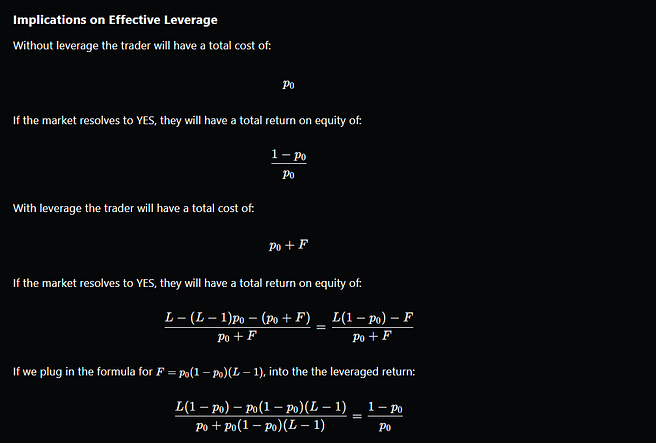
Equation showing the zero upside for adding leverage in fairly priced binary markets on PMs
In other words:
Under the instant-jump assumptions, the model’s fair financing fee removes the expected leverage benefit.
Why?
Because the financier must charge enough to compensate for the possibility of total loss in a single jump event. That cost scales with leverage.
The trader’s amplified gains are exactly offset by the financing cost required to make the system solvent.
This is not a regulatory constraint. It is a mathematical equilibrium.
And if it holds, it implies something radical:
This result applies to the financing assumptions shown; it does not prove that all binary-market products have identical economics.
What the model establishes
The central issue is the loss a lender cannot recover when a contract jumps through its liquidation level. Pricing that loss matters as much as quoting a leverage ratio. The fair-fee result discussed here belongs to a specified model, not a universal claim that leveraged event contracts are impossible.
Continue with leverage designs, epochs, auctions and pooled risk. For a different use of event contracts, read Prediction Frontier’s corporate-hedging analysis.